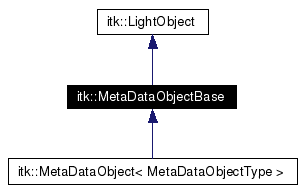
#include <itkMetaDataObjectBase.h>
Inheritance diagram for itk::MetaDataObjectBase:
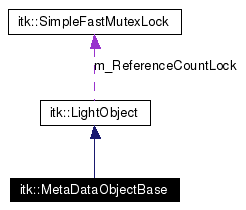
Definition at line 38 of file itkMetaDataObjectBase.h.
Public Types | |
| typedef SmartPointer< const Self > | ConstPointer |
| typedef SmartPointer< Self > | Pointer |
| typedef MetaDataObjectBase | Self |
| typedef LightObject | Superclass |
Public Member Functions | |
| virtual Pointer | CreateAnother () const |
| virtual void | Delete () |
| virtual const std::type_info & | GetMetaDataObjectTypeInfo (void) const |
| virtual const char * | GetMetaDataObjectTypeName (void) const |
| virtual const char * | GetNameOfClass () const |
| virtual int | GetReferenceCount () const |
| void | Print (std::ostream &os, Indent indent=0) const |
| virtual void | Print (std::ostream &os) const |
| virtual void | Register () const |
| virtual void | SetReferenceCount (int) |
| virtual void | UnRegister () const |
Static Public Member Functions | |
| static void | BreakOnError () |
Protected Member Functions | |
| MetaDataObjectBase () | |
| virtual void | PrintTrailer (std::ostream &os, Indent indent) const |
| *Default destructor *virtual | ~MetaDataObjectBase () |
Static Protected Member Functions | |
| static Pointer | New (void) |
Protected Attributes | |
| int | m_ReferenceCount |
| SimpleFastMutexLock | m_ReferenceCountLock |
| Methods invoked by virtual Print() to print information about the object *including superclasses.Typically not called by the user(use Print()*instead) but used in the hierarchical print process to combine the *output of several classes.*/virtual void PrintSelf(std voi | PrintHeader )(std::ostream &os, Indent indent) const |
|
|
Reimplemented from itk::LightObject. Reimplemented in itk::MetaDataObject< MetaDataObjectType >. Definition at line 45 of file itkMetaDataObjectBase.h. |
|
|
Reimplemented from itk::LightObject. Reimplemented in itk::MetaDataObject< MetaDataObjectType >. Definition at line 44 of file itkMetaDataObjectBase.h. |
|
|
Smart pointer typedef support. Reimplemented from itk::LightObject. Reimplemented in itk::MetaDataObject< MetaDataObjectType >. Definition at line 42 of file itkMetaDataObjectBase.h. |
|
|
Reimplemented in itk::MetaDataObject< MetaDataObjectType >. Definition at line 43 of file itkMetaDataObjectBase.h. |
|
|
|
|
|
|
|
|
This method is called when itkExceptionMacro executes. It allows the debugger to break on error. |
|
|
Create an object from an instance, potentially deferring to a factory. This method allows you to create an instance of an object that is exactly the same type as the referring object. This is useful in cases where an object has been cast back to a base class. Reimplemented in itk::Object. |
|
|
Delete an itk object. This method should always be used to delete an object when the new operator was used to create it. Using the C delete method will not work with reference counting. |
|
|
Reimplemented in itk::MetaDataObject< MetaDataObjectType >. |
|
|
Reimplemented in itk::MetaDataObject< MetaDataObjectType >. |
|
|
Run-time type information (and related methods). Reimplemented from itk::LightObject. Reimplemented in itk::MetaDataObject< MetaDataObjectType >. |
|
|
Gets the reference count on this object. Definition at line 98 of file itkLightObject.h. |
|
|
Method for creation through the object factory. Reimplemented from itk::LightObject. |
|
||||||||||||
|
Cause the object to print itself out. |
|
|
Defines the default behavior for printing out this element
Reimplemented in itk::MetaDataObject< MetaDataObjectType >. |
|
||||||||||||
|
|
|
|
Increase the reference count (mark as used by another object). Reimplemented in itk::Object. |
|
|
Sets the reference count on this object. This is a dangerous method, use it with care. Reimplemented in itk::Object. |
|
|
Decrease the reference count (release by another object). Reimplemented in itk::Object. |
|
|
Number of uses of this object by other objects. Definition at line 119 of file itkLightObject.h. |
|
|
Mutex lock to protect modification to the reference count Definition at line 122 of file itkLightObject.h. |
|
|
|
 1.4.2 written by Dimitri van Heesch,
© 1997-2000
1.4.2 written by Dimitri van Heesch,
© 1997-2000