#include <itkVectorGradientMagnitudeImageFilter.h>
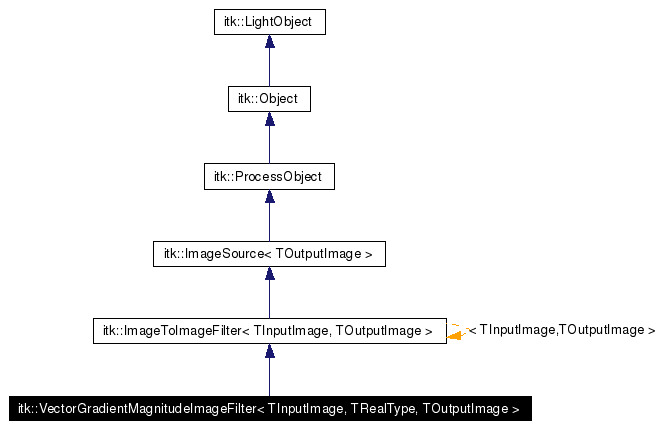
Inheritance diagram for itk::VectorGradientMagnitudeImageFilter< TInputImage, TRealType, TOutputImage >:
 , where
  * is the
  channel of vector image
  of dimension
  . * Weighting terms are applied to each vector component.
The second mode is computationally much faster than the first and has the advantage that it is automatically multi-threaded (some vnl functions used in the first mode are not thread-safe). The first mode, however, tends to give intuitively better results with less (or no) parameter tuning.
The third template parameter is the output image type. The third parameter will be automatically constructed from the first and second parameters, so it is not necessary (or advisable) to set this parameter explicitly. Given an M-channel input image with dimensionality N, and a numerical type specified as TRealType, the output image will be of type itk::Image<itk::Vector<TRealType, M>, N>.
Weights can be applied to the derivatives directly using the SetDerivativeWeights method. Note that if UseImageSpacing is set to TRUE (ON), then these weights will be overridden by weights derived from the image spacing when the filter is updated. The argument to this method is a C array of TRealValue type.
Weights can be applied to each vector component of the image when the component derivative values are summed during computation. Specify these weights using the SetComponentWeights method. The argument to this method is a C array of TRealValue type.
Definition at line 138 of file itkVectorGradientMagnitudeImageFilter.h.
Public Types | |
| typedef ConstNeighborhoodIterator< RealVectorImageType > | ConstNeighborhoodIteratorType |
| typedef SmartPointer< const Self > | ConstPointer |
| typedef DataObject::Pointer | DataObjectPointer |
| typedef std::vector< DataObjectPointer > | DataObjectPointerArray |
| typedef InputImageType::ConstPointer | InputImageConstPointer |
| typedef InputImageType::PixelType | InputImagePixelType |
| typedef InputImageType::Pointer | InputImagePointer |
| typedef InputImageType::RegionType | InputImageRegionType |
| typedef TInputImage | InputImageType |
| typedef TInputImage::PixelType | InputPixelType |
| typedef OutputImageType::PixelType | OutputImagePixelType |
| typedef OutputImageType::Pointer | OutputImagePointer |
| typedef Superclass::OutputImageRegionType | OutputImageRegionType |
| typedef TOutputImage | OutputImageType |
| typedef TOutputImage::PixelType | OutputPixelType |
| typedef SmartPointer< Self > | Pointer |
| typedef ConstNeighborhoodIteratorType::RadiusType | RadiusType |
| typedef TRealType | RealType |
| typedef Image< RealVectorType, ::itk::GetImageDimension< TInputImage >::ImageDimension > | RealVectorImageType |
| typedef Vector< TRealType, ::itk::GetVectorDimension< InputPixelType >::VectorDimension > | RealVectorType |
| typedef VectorGradientMagnitudeImageFilter | Self |
| typedef ImageToImageFilter< TInputImage, TOutputImage > | Superclass |
Public Member Functions | |
| virtual void | AbortGenerateDataOff () |
| virtual void | AbortGenerateDataOn () |
| virtual LightObject::Pointer | CreateAnother () const |
| virtual void | DebugOff () const |
| virtual void | DebugOn () const |
| virtual void | Delete () |
| virtual void | EnlargeOutputRequestedRegion (DataObject *) |
| virtual void | GenerateInputRequestedRegion () throw (InvalidRequestedRegionError) |
| virtual const bool & | GetAbortGenerateData () |
| Command * | GetCommand (unsigned long tag) |
| virtual const TRealType * | GetComponentWeights () const |
| bool | GetDebug () const |
| virtual const TRealType * | GetDerivativeWeights () const |
| const InputImageType * | GetInput (unsigned int idx) |
| const InputImageType * | GetInput (void) |
| DataObjectPointerArray & | GetInputs () |
| const MetaDataDictionary & | GetMetaDataDictionary (void) const |
| MetaDataDictionary & | GetMetaDataDictionary (void) |
| virtual unsigned long | GetMTime () const |
| MultiThreader * | GetMultiThreader () |
| virtual const char * | GetNameOfClass () const |
| std::vector< DataObjectPointer >::size_type | GetNumberOfInputs () const |
| std::vector< DataObjectPointer >::size_type | GetNumberOfOutputs () const |
| virtual const int & | GetNumberOfThreads () |
| virtual std::vector< DataObjectPointer >::size_type | GetNumberOfValidRequiredInputs () const |
| OutputImageType * | GetOutput (unsigned int idx) |
| Get the output data of this process object The output of this *function is not valid until an appropriate either explicitly or implicitly Both the filter *itself and the data object have and both *methods update the data Here are three ways to use * | GetOutput () and make sure the data is valid.In these *examples |
| Return an array with all the outputs of this process object *This is useful for tracing forward in the pipeline to contruct *graphs etc *DataObjectPointerArray & | GetOutputs () |
| virtual const float & | GetProgress () |
| virtual int | GetReferenceCount () const |
| virtual const bool & | GetReleaseDataBeforeUpdateFlag () |
| virtual bool | GetReleaseDataFlag () const |
| virtual bool | GetUseImageSpacing () |
| virtual bool | GetUsePrincipleComponents () |
| virtual void | GraftNthOutput (unsigned int idx, DataObject *output) |
| virtual void | GraftOutput (DataObject *output) |
| bool | HasObserver (const EventObject &event) const |
| Get the output data of this process object The output of this *function is not valid until an appropriate either explicitly or implicitly Both the filter *itself and the data object have and both *methods update the data Here are three ways to use *a image is a pointer to some Image and the *particular ProcessObjects involved are filters The same *examples apply to non | image (e.g.Mesh) data as well.**\code *anotherFilter->SetInput(someFilter->GetOutput()) |
| void | InvokeEvent (const EventObject &) const |
| void | InvokeEvent (const EventObject &) |
| itkStaticConstMacro (OutputImageDimension, unsigned int, TOutputImage::ImageDimension) | |
| ImageDimension constants * | itkStaticConstMacro (InputImageDimension, unsigned int, TInputImage::ImageDimension) |
| itkStaticConstMacro (VectorDimension, unsigned int, InputPixelType::Dimension) | |
| itkStaticConstMacro (ImageDimension, unsigned int, TOutputImage::ImageDimension) | |
| virtual DataObjectPointer | MakeOutput (unsigned int idx) |
| virtual void | Modified () const |
| virtual void | PopBackInput () |
| virtual void | PopFrontInput () |
| virtual void | PrepareOutputs () |
| void | Print (std::ostream &os, Indent indent=0) const |
| virtual void | PropagateRequestedRegion (DataObject *output) |
| Push Pop the input of this process object These methods allow a *filter to model its input vector as a queue or stack These *routines may not be appropriate for all especially *filters with different types of inputs These routines follow *the semantics of STL **The routines are useful for applications that need to process *rolling sets of images For if an application has *images and they need to run a filter on then *run the filter on then run the filter on the application can accomplish this by popping *an input off the front of the input list and push a new image *onto the back of input list this only makes sense for *filters that single type of input **Other uses are also possible For a single input pushing *and popping inputs allow the application to temporarily replace *an input to a filter **virtual void | PushBackInput (const InputImageType *image) |
| virtual void | PushFrontInput (const InputImageType *image) |
| virtual void | Register () const |
| virtual void | ReleaseDataBeforeUpdateFlagOff () |
| virtual void | ReleaseDataBeforeUpdateFlagOn () |
| void | ReleaseDataFlagOff () |
| void | ReleaseDataFlagOn () |
| void | RemoveAllObservers () |
| void | RemoveObserver (unsigned long tag) |
| virtual void | ResetPipeline () |
| virtual void | SetAbortGenerateData (bool _arg) |
| Set Get the array of weightings for the different components of the vector Default values are *virtual void | SetComponentWeights (TRealType data[]) |
| void | SetDebug (bool debugFlag) const |
| Directly Set Get the array of weights used in the gradient calculations Note that calling UseImageSpacingOn will clobber these values *void | SetDerivativeWeights (TRealType data[]) |
| virtual void | SetInput (unsigned int, const TInputImage *image) |
| Set Get the image input of this process object *virtual void | SetInput (const InputImageType *image) |
| void | SetMetaDataDictionary (const MetaDataDictionary &rhs) |
| Get Set the number of threads to create when executing *virtual void | SetNumberOfThreads (int _arg) |
| virtual void | SetProgress (float _arg) |
| virtual void | SetReferenceCount (int) |
| Turn on off the flags to control whether the bulk data belonging *to the outputs of this ProcessObject are released after being *used by a downstream ProcessObject Default value is off Another *options for controlling memory utilization is the *ReleaseDataBeforeUpdateFlag *virtual void | SetReleaseDataFlag (bool flag) |
| Set Get whether or not the filter will use the spacing of the input image in its calculations *void | SetUseImageSpacing (bool) |
| void | SetUseImageSpacingOff () |
| void | SetUseImageSpacingOn () |
| void | SetUsePrincipleComponentsOff () |
| void | SetUsePrincipleComponentsOn () |
| virtual void | UnRegister () const |
| *endcode *In the above the two lines of code can be in *either order **Note that it may be more efficient to *use a pipeline than to call | Update () once for each filter in *turn.**For an image |
| *endcode *In the above the two lines of code can be in *either order **Note that | Update () is not called automatically except within a *pipeline as in the first example.When\b streaming(using a *StreamingImageFilter) is activated |
| *endcode **code *someFilter | Update () |
| *image | Update () |
| *anotherFilter | Update () |
| Get the output data of this process object The output of this *function is not valid until an appropriate either explicitly or implicitly Both the filter *itself and the data object have | Update () methods |
| Get the output data of this process object The output of this *function is not valid until an appropriate | Update () method has *been called |
| virtual void | UpdateLargestPossibleRegion () |
| virtual void | UpdateOutputData (DataObject *output) |
| virtual void | UpdateOutputInformation () |
| void | UpdateProgress (float amount) |
Static Public Member Functions | |
| static void | BreakOnError () |
| static int | CubicSolver (double *, double *) |
| static bool | GetGlobalWarningDisplay () |
| static void | GlobalWarningDisplayOff () |
| static void | GlobalWarningDisplayOn () |
| static Pointer | New () |
| This is a global flag that controls whether any warning *or error messages are displayed *static void | SetGlobalWarningDisplay (bool flag) |
Public Attributes | |
| Allow people to add remove invoke observers(callbacks) to any ITK *object.This is an implementation of the subject/observer design *pattern.An observer is added by specifying an event to respond to *and an itk unsigned lon | AddObserver )(const EventObject &event, Command *) const |
| Push Pop the input of this process object These methods allow a *filter to model its input vector as a queue or stack These *routines may not be appropriate for all especially *filters with different types of inputs These routines follow *the semantics of STL **The routines are useful for applications that need to process *rolling sets of images For if an application has *images and they need to run a filter on then *run the filter on then run the filter on the application can accomplish this by popping *an input off the front of the input list and push a new image *onto the back of input list | Again |
| This is a global flag that controls whether any | debug |
| *endcode *In the above | example |
| Push Pop the input of this process object These methods allow a *filter to model its input vector as a queue or stack These *routines may not be appropriate for all especially *filters with different types of inputs These routines follow *the semantics of STL **The routines are useful for applications that need to process *rolling sets of images For if an application has *images and they need to run a filter on then *run the filter on then run the filter on the application can accomplish this by popping *an input off the front of the input list and push a new image *onto the back of input list this only makes sense for *filters that single type of input **Other uses are also possible For a single input | filter |
| Push Pop the input of this process object These methods allow a *filter to model its input vector as a queue or stack These *routines may not be appropriate for all | filters |
| * | image = someFilter->GetOutput() |
| *endcode **In this a someFilter and a anotherFilter are said *to constitute a b pipeline **code * | image = someFilter->GetOutput() |
| Push Pop the input of this process object These methods allow a *filter to model its input vector as a queue or stack These *routines may not be appropriate for all especially *filters with different types of inputs These routines follow *the semantics of STL **The routines are useful for applications that need to process *rolling sets of images For if an application has *images and they need to run a filter on then *run the filter on then run the filter on * | images |
| Push Pop the input of this process object These methods allow a *filter to model its input vector as a queue or stack These *routines may not be appropriate for all especially *filters with different types of inputs These routines follow *the semantics of STL **The routines are useful for applications that need to process *rolling sets of images For if an application has *images and they need to run a filter on then *run the filter on | images |
| Push Pop the input of this process object These methods allow a *filter to model its input vector as a queue or stack These *routines may not be appropriate for all especially *filters with different types of inputs These routines follow *the semantics of STL **The routines are useful for applications that need to process *rolling sets of images For if an application has *images and they need to run a filter on | images |
| Push Pop the input of this process object These methods allow a *filter to model its input vector as a queue or stack These *routines may not be appropriate for all especially *filters with different types of inputs These routines follow *the semantics of STL **The routines are useful for applications that need to process *rolling sets of images For | instance |
| Get the output data of this process object The output of this *function is not valid until an appropriate either explicitly or implicitly Both the filter *itself and the data object have and both *methods update the data Here are three ways to use *a image is a pointer to some Image | object |
| Set Get principle components calculation mode When this is set to TRUE the gradient calculation will involve a priniciple component analysis of the partial derivatives of the color components When this value is set to FALSE | OFF |
| Set Get principle components calculation mode When this is set to TRUE | ON |
| *endcode *In the above the two lines of code can be in *either order **Note that it may be more efficient to *use a pipeline than to call the data generated is for the requested * | Region |
| *endcode **In this | situation |
| Set Get principle components calculation mode When this is set to TRUE the gradient calculation will involve a priniciple component analysis of the partial derivatives of the color components When this value is set to FALSE the calculation is done as a square root of weighted sum of the derivatives squared Default is | UsePrincipleComponents |
Protected Types | |
| typedef InputImageType::Superclass | ImageBaseType |
| typedef ImageToImageFilterDetail::ImageRegionCopier< itkGetStaticConstMacro(OutputImageDimension), itkGetStaticConstMacro(InputImageDimension) | InputToOutputRegionCopierType ) |
| typedef ImageToImageFilterDetail::ImageRegionCopier< itkGetStaticConstMacro(InputImageDimension), itkGetStaticConstMacro(OutputImageDimension) | OutputToInputRegionCopierType ) |
Protected Member Functions | |
| virtual void | AddInput (DataObject *input) |
| virtual void | AddOutput (DataObject *output) |
| virtual void | AfterThreadedGenerateData () |
| virtual void | AllocateOutputs () |
| void | BeforeThreadedGenerateData () |
| virtual void | CacheInputReleaseDataFlags () |
| virtual void | CallCopyInputRegionToOutputRegion (OutputImageRegionType &destRegion, const InputImageRegionType &srcRegion) |
| virtual void | CallCopyOutputRegionToInputRegion (InputImageRegionType &destRegion, const OutputImageRegionType &srcRegion) |
| TRealType | EvaluateAtNeighborhood (const ConstNeighborhoodIteratorType &it) const |
| TRealType | EvaluateAtNeighborhood3D (const ConstNeighborhoodIteratorType &it) const |
| virtual void | GenerateData () |
| virtual void | GenerateOutputInformation () |
| virtual void | GenerateOutputRequestedRegion (DataObject *output) |
| const DataObject * | GetInput (unsigned int idx) const |
| Get Set the neighborhood radius used for gradient computation *virtual const RadiusType & | GetNeighborhoodRadius () |
| virtual const unsigned int & | GetNumberOfRequiredInputs () |
| virtual const unsigned int & | GetNumberOfRequiredOutputs () |
| const DataObject * | GetOutput (unsigned int idx) const |
| virtual const ImageBaseType * | GetRealValuedInputImage () |
| ImageToImageFilter () | |
| TRealType | NonPCEvaluateAtNeighborhood (const ConstNeighborhoodIteratorType &it) const |
| bool | PrintObservers (std::ostream &os, Indent indent) const |
| void | PrintSelf (std::ostream &os, Indent indent) const |
| virtual void | PrintTrailer (std::ostream &os, Indent indent) const |
| virtual void | PropagateResetPipeline () |
| **these methods end of hiding the versions from the superclass *ProcessObject whose arguments are DataObjects we re expose *the versions from ProcessObject to avoid warnings about hiding *methods from the superclass *void | PushBackInput (const DataObject *input) |
| * | PushBackInput () |
| * | PushFronInput () in the public section force the *input to be the type expected by an ImageToImageFilter.However |
| void | PushFrontInput (const DataObject *input) |
| virtual void | ReleaseInputs () |
| virtual void | RemoveInput (DataObject *input) |
| virtual void | RemoveOutput (DataObject *output) |
| virtual void | RestoreInputReleaseDataFlags () |
| virtual void | SetNeighborhoodRadius (RadiusType _arg) |
| Protected methods for setting inputs *Subclasses make use of them for setting input *virtual void | SetNthInput (unsigned int num, DataObject *input) |
| Protected methods for setting outputs *Subclasses make use of them for getting output *virtual void | SetNthOutput (unsigned int num, DataObject *output) |
| void | SetNumberOfInputs (unsigned int num) |
| void | SetNumberOfOutputs (unsigned int num) |
| virtual void | SetNumberOfRequiredInputs (unsigned int _arg) |
| virtual void | SetNumberOfRequiredOutputs (unsigned int _arg) |
| virtual int | SplitRequestedRegion (int i, int num, OutputImageRegionType &splitRegion) |
| void | ThreadedGenerateData (const OutputImageRegionType &outputRegionForThread, int threadId) |
| VectorGradientMagnitudeImageFilter () | |
| virtual | ~VectorGradientMagnitudeImageFilter () |
Static Protected Member Functions | |
| static ITK_THREAD_RETURN_TYPE | ThreaderCallback (void *arg) |
Protected Attributes | |
| **these methods end of hiding the versions from the superclass *ProcessObject whose arguments are DataObjects | Here |
| TRealType | m_ComponentWeights [itk::GetVectorDimension< InputPixelType >::VectorDimension] |
| TRealType | m_DerivativeWeights [itk::GetImageDimension< TInputImage >::ImageDimension] |
| TimeStamp | m_OutputInformationMTime |
| int | m_ReferenceCount |
| SimpleFastMutexLock | m_ReferenceCountLock |
| TRealType | m_SqrtComponentWeights [itk::GetVectorDimension< InputPixelType >::VectorDimension] |
| bool | m_Updating |
| Methods invoked by virtual Print() to print information about the object *including superclasses.Typically not called by the user(use Print()*instead) but used in the hierarchical print process to combine the *output of several classes.*/virtual void PrintSelf(std voi | PrintHeader )(std::ostream &os, Indent indent) const |
|
|||||
|
Type of the iterator that will be used to move through the image. Also the type which will be passed to the evaluate function Definition at line 181 of file itkVectorGradientMagnitudeImageFilter.h. |
|
|||||
|
Reimplemented from itk::ImageToImageFilter< TInputImage, TOutputImage >. Definition at line 146 of file itkVectorGradientMagnitudeImageFilter.h. |
|
|||||
|
Smart Pointer type to a DataObject. Reimplemented from itk::ProcessObject. Reimplemented in itk::LabelStatisticsImageFilter< TInputImage, TLabelImage >, itk::MinimumMaximumImageFilter< TInputImage >, itk::StatisticsImageFilter< TInputImage >, and itk::StreamingImageFilter< TInputImage, TOutputImage >. Definition at line 62 of file itkImageSource.h. |
|
|
STL Array of SmartPointers to DataObjects Definition at line 103 of file itkProcessObject.h. |
|
|||||
|
Definition at line 283 of file itkVectorGradientMagnitudeImageFilter.h. |
|
|
|
|||||
|
Reimplemented from itk::ImageToImageFilter< TInputImage, TOutputImage >. Definition at line 162 of file itkVectorGradientMagnitudeImageFilter.h. |
|
|
|||||
|
Image typedef support Reimplemented from itk::ImageToImageFilter< TInputImage, TOutputImage >. Definition at line 160 of file itkVectorGradientMagnitudeImageFilter.h. |
|
|||||
|
Definition at line 157 of file itkVectorGradientMagnitudeImageFilter.h. |
|
|
Typedef for the region copier function object that converts an input region to an output region. Definition at line 163 of file itkImageToImageFilter.h. |
|
|||||
|
|||||
|
Reimplemented from itk::ImageSource< TOutputImage >. Definition at line 163 of file itkVectorGradientMagnitudeImageFilter.h. |
|
|||||
|
Superclass typedefs. Reimplemented from itk::ImageToImageFilter< TInputImage, TOutputImage >. Definition at line 185 of file itkVectorGradientMagnitudeImageFilter.h. |
|
|||||
|
Some convenient typedefs. Reimplemented from itk::ImageSource< TOutputImage >. Definition at line 161 of file itkVectorGradientMagnitudeImageFilter.h. |
|
|||||
|
Extract some information from the image types. Dimensionality of the two images is assumed to be the same. Definition at line 152 of file itkVectorGradientMagnitudeImageFilter.h. |
|
|
Typedef for the region copier function object that converts an output region to an input region. Definition at line 168 of file itkImageToImageFilter.h. |
|
|||||
|
Reimplemented from itk::ImageToImageFilter< TInputImage, TOutputImage >. Definition at line 145 of file itkVectorGradientMagnitudeImageFilter.h. |
|
|||||
|
Definition at line 182 of file itkVectorGradientMagnitudeImageFilter.h. |
|
|||||
|
Define the data type and the vector of data type used in calculations. Definition at line 174 of file itkVectorGradientMagnitudeImageFilter.h. |
|
|||||
|
Definition at line 176 of file itkVectorGradientMagnitudeImageFilter.h. |
|
|||||
|
Definition at line 175 of file itkVectorGradientMagnitudeImageFilter.h. |
|
|||||
|
Standard class typedefs. Reimplemented from itk::ImageToImageFilter< TInputImage, TOutputImage >. Definition at line 143 of file itkVectorGradientMagnitudeImageFilter.h. |
|
|||||
|
Reimplemented from itk::ImageToImageFilter< TInputImage, TOutputImage >. Definition at line 144 of file itkVectorGradientMagnitudeImageFilter.h. |
|
|||||||||
|
|
|
|||||||||
|
Definition at line 260 of file itkVectorGradientMagnitudeImageFilter.h. |
|
|
|
|
|
Turn on and off the AbortGenerateData flag. |
|
|
|
|
|
|
|
|||||||||
|
|||||||||
|
|||||||||
|
Do any necessary casting/copying of the input data. Input pixel types whose value types are not real number types must be cast to real number types. Reimplemented from itk::ImageSource< TOutputImage >. |
|
|
This method is called when itkExceptionMacro executes. It allows the debugger to break on error. |
|
|
Cache the state of any ReleaseDataFlag's on the inputs. While the filter is executing, we need to set the ReleaseDataFlag's on the inputs to false in case the current filter is implemented using a mini-pipeline (which will try to release the inputs). After the filter finishes, we restore the state of the ReleaseDataFlag's before the call to ReleaseInputs(). |
|
||||||||||||
|
This function calls the actual region copier to do the mapping from input image space to output image space. It uses a Function object used for dispatching to various routines to copy an input region (start index and size) to an output region. For most filters, this is a trivial copy because most filters require the input dimension to match the output dimension. However, some filters like itk::UnaryFunctorImageFilter can support output images of a higher dimension that the input. This function object is used by the default implementation of GenerateOutputInformation(). It can also be used in routines like ThreadedGenerateData() where a filter may need to map an input region to an output region. The default copier uses a "dispatch pattern" to call one of three overloaded functions depending on whether the input and output images are the same dimension, the input is a higher dimension that the output, or the input is of a lower dimension than the output. The use of an overloaded function is required for proper compilation of the various cases. For the latter two cases, trivial implementations are used. If the input image is a higher dimension than the output, the first portion of the input region is copied to the output region. If the input region is a lower dimension than the output, the input region information is copied into the first portion of the output region and the rest of the output region is set to zero. If a filter needs a different default behavior, it can override this method. |
|
||||||||||||
|
This function calls the actual region copier to do the mapping from output image space to input image space. It uses a Function object used for dispatching to various routines to copy an output region (start index and size) to an input region. For most filters, this is a trivial copy because most filters require the input dimension to match the output dimension. However, some filters like itk::ExtractImageFilter can support output images of a lower dimension that the input. This function object can be used by GenerateOutputInformation() to copy the input LargestPossibleRegion to the output LargestPossibleRegion and can also be used in GenerateData or ThreadedGenerateData() where a filter may need to map an output region to an input region. The default copier uses a "dispatch pattern" to call one of three overloaded functions depending on whether the input and output images are the same dimension, the input is a higher dimension that the output, or the input is of a lower dimension than the output. The use of an overloaded function is required for proper compilation of the various cases. For the latter two cases, trivial implementations are used. If the input image is a higher dimension than the output, the output region information is copied into the first portion of the input region and the rest of the input region is set to zero. If the input region is a lower dimension than the output, the first portion of the output region is copied to the input region. If a filter needs a different default behavior, it can override this method. The ExtractImageFilter overrides this function object so that if the input image is a higher dimension than the output image, the filter can control "where" in the input image the output subimage is extracted (as opposed to mapping to first few dimensions of the input). Reimplemented in itk::ExtractImageFilter< TInputImage, TOutputImage >. |
|
|
Create an object from an instance, potentially deferring to a factory. This method allows you to create an instance of an object that is exactly the same type as the referring object. This is useful in cases where an object has been cast back to a base class. Reimplemented from itk::LightObject. |
|
||||||||||||||||
|
A specialized solver for finding the roots of a cubic polynomial. Necessary to multi-thread the 3D case |
|
|
Turn debugging output off. |
|
|
Turn debugging output on. |
|
|
Delete an itk object. This method should always be used to delete an object when the new operator was used to create it. Using the C delete method will not work with reference counting. |
|
|
||||||||||
|
Definition at line 412 of file itkVectorGradientMagnitudeImageFilter.h. References itk::ConstNeighborhoodIterator< TImage, TBoundaryCondition >::GetNext(), and itk::ConstNeighborhoodIterator< TImage, TBoundaryCondition >::GetPrevious(). |
|
||||||||||
|
|||||||||
|
|||||||||
|
VectorGradientMagnitudeImageFilter needs a larger input requested region than the output requested region (larger by the kernel size to calculate derivatives). As such, VectorGradientMagnitudeImageFilter needs to provide an implementation for GenerateInputRequestedRegion() in order to inform the pipeline execution model.
Reimplemented from itk::ImageToImageFilter< TInputImage, TOutputImage >. |
|
|
|
Given one output whose requested region has been set, how should the requested regions for the remaining outputs of the process object be set? By default, all the outputs are set to the same requested region. If a filter needs to produce different requested regions for each output, for instance an image processing filter producing several outputs at different resolutions, then that filter may override this method and set the requested regions appropriatedly. Note that a filter producing multiple outputs of different types is required to override this method. The default implementation can only correctly handle multiple outputs of the same type. Reimplemented in itk::MultiResolutionPyramidImageFilter< TInputImage, TOutputImage >, itk::RecursiveMultiResolutionPyramidImageFilter< TInputImage, TOutputImage >, itk::watershed::BoundaryResolver< TPixelType, TDimension >, itk::watershed::EquivalenceRelabeler< TScalarType, TImageDimension >, itk::watershed::Relabeler< TScalarType, TImageDimension >, itk::watershed::Segmenter< TInputImage >, itk::watershed::SegmentTreeGenerator< TScalarType >, itk::watershed::Relabeler< ScalarType, itkGetStaticConstMacro(ImageDimension)>, and itk::watershed::SegmentTreeGenerator< ScalarType >. |
|
|
Get the AbortGenerateData flag for the process object. Process objects may handle premature termination of execution in different ways. |
|
|
Get the command associated with the given tag. NOTE: This returns a pointer to a Command, but it is safe to asign this to a Command::Pointer. Since Command inherits from LightObject, at this point in the code, only a pointer or a reference to the Command can be used. |
|
|||||||||
|
|
|
|
Get the value of the debug flag. |
|
|||||||||
|
|
|
|
|
|
|
|
|
|
Reimplemented from itk::ProcessObject. |
|
|
|
|
|
Return an array with all the inputs of this process object. This is useful for tracing back in the pipeline to construct graphs etc. Definition at line 108 of file itkProcessObject.h. |
|
|
|
|
|
|
|
|
|
Return the multithreader used by this class. Definition at line 281 of file itkProcessObject.h. |
|
|||||||||
|
Run-time type information (and related methods) Reimplemented from itk::ImageToImageFilter< TInputImage, TOutputImage >. |
|
|||||||||
|
|
|
|
Get the size of the input vector. This is merely the size of the input vector, not the number of inputs that have valid DataObject's assigned. Use GetNumberOfValidRequiredInputs() to determine how many inputs are non-null. Definition at line 115 of file itkProcessObject.h. |
|
|
Definition at line 132 of file itkProcessObject.h. |
|
|
|
|
|
|
|
|
|
|
|
Get the number of valid inputs. This is the number of non-null entries in the input vector in the first NumberOfRequiredInputs slots. This method is used to determine whether the necessary required inputs have been set. Subclasses of ProcessObject may override this implementation if the required inputs are not the first slots in input vector. Reimplemented in itk::MultiResolutionPDEDeformableRegistration< TFixedImage, TMovingImage, TDeformationField >, and itk::PDEDeformableRegistrationFilter< TFixedImage, TMovingImage, TDeformationField >. |
|
|
|
|
||||||||||
|
Reimplemented from itk::ProcessObject. |
|
||||||||||
|
|
|
|
Definition at line 130 of file itkProcessObject.h. |
|
|
Get the execution progress of a process object. The progress is a floating number in [0,1] with 0 meaning no progress and 1 meaning the filter has completed execution. |
|
|||||||||
|
Get access to the input image casted as real pixel values |
|
|
Gets the reference count on this object. Definition at line 98 of file itkLightObject.h. |
|
|
|
|
|
|
|
|||||||||
|
|
|
|||||||||
|
|
|
|
Definition at line 100 of file itkObject.h. References itk::Object::SetGlobalWarningDisplay(). |
|
|
Definition at line 98 of file itkObject.h. References itk::Object::SetGlobalWarningDisplay(). |
|
||||||||||||||||
|
Graft the specified data object onto this ProcessObject's idx'th output. This is the similar to GraftOutput method except is allows you specify which output is affected. The specified index must be a valid output number (less than ProcessObject::GetNumberOfOutputs()). See the GraftOutput for general usage information. |
|
||||||||||
|
Graft the specified DataObject onto this ProcessObject's output. This method grabs a handle to the specified DataObject's bulk data to used as its output's own bulk data. It also copies the region ivars (RequestedRegion, BufferedRegion, LargestPossibleRegion) and meta-data (Spacing, Origin) from the specified data object into this filter's output data object. Most importantly, however, it leaves the Source ivar untouched so the original pipeline routing is intact. This method is used when a process object is implemented using a mini-pipeline which is defined in its GenerateData() method. The usage is:
    // setup the mini-pipeline to process the input to this filter
    firstFilterInMiniPipeline->SetInput( this->GetInput() );

    // setup the mini-pipeline to calculate the correct regions
    // and write to the appropriate bulk data block
    lastFilterInMiniPipeline->GraftOutput( this->GetOutput() );

    // execute the mini-pipeline
    lastFilterInMiniPipeline->Update();

    // graft the mini-pipeline output back onto this filter's output.
    // this is needed to get the appropriate regions passed back.
    this->GraftOutput( lastFilterInMiniPipeline->GetOutput() );
For proper pipeline execution, a filter using a mini-pipeline must implement the GenerateInputRequestedRegion(), GenerateOutputRequestedRegion(), GenerateOutputInformation() and EnlargeOutputRequestedRegion() methods as necessary to reflect how the mini-pipeline will execute (in other words, the outer filter's pipeline mechanism must be consistent with what the mini-pipeline will do). |
|
|
Return true if an observer is registered for this event. |
|
||||||||||
|
|
|
|
|
|
|
Call Execute on all the Commands observing this event id. The actions triggered by this call doesn't modify this object. |
|
|
Call Execute on all the Commands observing this event id. |
|
||||||||||||||||
|
||||||||||||||||
|
||||||||||||||||||||
|
Length of the vector pixel type of the input image. |
|
||||||||||||||||||||
|
The dimensionality of the input and output images. |
|
||||||||||
|
Make a DataObject of the correct type to used as the specified output. Every ProcessObject subclass must be able to create a DataObject that can be used as a specified output. This method is automatically called when DataObject::DisconnectPipeline() is called. DataObject::DisconnectPipeline, disconnects a data object from being an output of its current source. When the data object is disconnected, the ProcessObject needs to construct a replacement output data object so that the ProcessObject is in a valid state. So DataObject::DisconnectPipeline eventually calls ProcessObject::MakeOutput. Note that MakeOutput always returns a SmartPointer to a DataObject. If a subclass of ImageSource has multiple outputs of different types, then that class must provide an implementation of MakeOutput(). Reimplemented from itk::ProcessObject. Reimplemented in itk::EigenAnalysis2DImageFilter< TInputImage, TEigenValueImage, TEigenVectorImage >, itk::MinimumMaximumImageFilter< TInputImage >, and itk::StatisticsImageFilter< TInputImage >. |
|
|
|||||||||
|
Method for creation through the object factory. Reimplemented from itk::Object. |
|
||||||||||
|
Definition at line 294 of file itkVectorGradientMagnitudeImageFilter.h. References itk::ConstNeighborhoodIterator< TImage, TBoundaryCondition >::GetNext(), and itk::ConstNeighborhoodIterator< TImage, TBoundaryCondition >::GetPrevious(). |
|
|
Reimplemented from itk::ProcessObject. |
|
|
Reimplemented from itk::ProcessObject. |
|
|
An opportunity to deallocate a ProcessObject's bulk data storage. Some filters may wish to reuse existing bulk data storage to avoid unnecessary deallocation/allocation sequences. The default implementation calls Initialize() on each output. DataObject::Initialize() frees its bulk data by default. Reimplemented in itk::WatershedImageFilter< TInputImage >. |
|
||||||||||||
|
Cause the object to print itself out. |
|
||||||||||||
|
|
|
||||||||||||||||
|
Methods invoked by Print() to print information about the object including superclasses. Typically not called by the user (use Print() instead) but used in the hierarchical print process to combine the output of several classes. Reimplemented from itk::ImageToImageFilter< TInputImage, TOutputImage >. |
|
||||||||||||
|
|
|
|
Send the requested region information back up the pipeline (to the filters that preceed this one). Reimplemented in itk::VTKImageImport< TOutputImage >. |
|
|
Propagate a call to ResetPipeline() up the pipeline. Called only from DataObject. |
|
|
Reimplemented from itk::ProcessObject. Definition at line 250 of file itkImageToImageFilter.h. |
|
|
|
|
|
|
|
|
|
|
|
Reimplemented from itk::ProcessObject. Definition at line 252 of file itkImageToImageFilter.h. |
|
|
|
|
|
Increase the reference count (mark as used by another object). Reimplemented from itk::LightObject. |
|
|
|
|
|
|
|
|
Definition at line 254 of file itkProcessObject.h. |
|
|
Definition at line 253 of file itkProcessObject.h. |
|
|
|
Remove all observers . |
|
|
|
|
|
Remove the observer with this tag value. |
|
|
|
|
|
Reset the pipeline. If an exception is thrown during an Update(), the pipeline may be in an inconsistent state. This method clears the internal state of the pipeline so Update() can be called. |
|
|
Restore the cached input ReleaseDataFlags. |
|
|
Set the AbortGenerateData flag for the process object. Process objects may handle premature termination of execution in different ways. |
|
||||||||||
|
|
|
|
Set the value of the debug flag. A non-zero value turns debugging on. |
|
||||||||||
|
|
|
|
Referenced by itk::Object::GlobalWarningDisplayOff(), and itk::Object::GlobalWarningDisplayOn(). |
|
||||||||||||
|
|
|
|
|
|
|
|
|
||||||||||
|
|
|
||||||||||||
|
||||||||||||
|
|
Called to allocate the input array. Copies old inputs. |
|
|
Called to allocate the output array. Copies old outputs. |
|
|
|
|
|
|
|
|
|
|
|
Set the execution progress of a process object. The progress is a floating number in [0,1] with 0 meaning no progress and 1 meaning the filter has completed execution. The ProgressEvent is NOT invoked. |
|
|
Sets the reference count (use with care) Reimplemented from itk::LightObject. |
|
|
|
|
||||||||||
|
|
|
|||||||||
|
Reset the derivative weights to ignore image spacing. Use this option if you want to calculate the gradient in the image space. Default is ImageSpacingOff. Definition at line 206 of file itkVectorGradientMagnitudeImageFilter.h. |
|
|||||||||
|
Set the derivative weights according to the spacing of the input image (1/spacing). Use this option if you want to calculate the gradient in the space in which the data was acquired. Definition at line 200 of file itkVectorGradientMagnitudeImageFilter.h. |
|
|||||||||
|
Definition at line 238 of file itkVectorGradientMagnitudeImageFilter.h. |
|
|||||||||
|
Definition at line 234 of file itkVectorGradientMagnitudeImageFilter.h. |
|
||||||||||||||||||||
|
Split the output's RequestedRegion into "num" pieces, returning region "i" as "splitRegion". This method is called "num" times. The regions must not overlap. The method returns the number of pieces that the routine is capable of splitting the output RequestedRegion, i.e. return value is less than or equal to "num". |
|
||||||||||||||||
|
VectorGradientMagnitudeImageFilter can be implemented as a multithreaded filter. Therefore, this implementation provides a ThreadedGenerateData() routine which is called for each processing thread. The output image data is allocated automatically by the superclass prior to calling ThreadedGenerateData(). ThreadedGenerateData can only write to the portion of the output image specified by the parameter "outputRegionForThread"
Reimplemented from itk::ImageSource< TOutputImage >. |
|
||||||||||
|
Static function used as a "callback" by the MultiThreader. The threading library will call this routine for each thread, which will delegate the control to ThreadedGenerateData(). |
|
|
Decrease the reference count (release by another object). Reimplemented from itk::LightObject. |
|
|||||||||
|
Bring this filter up-to-date. Update() checks modified times against last execution times, and re-executes objects if necessary. A side effect of this method is that the whole pipeline may execute in order to bring this filter up-to-date. This method updates the currently prescribed requested region. If no requested region has been set on the output, then the requested region will be set to the largest possible region. Once the requested region is set, Update() will make sure the specified requested region is up-to-date. This is a confusing side effect to users who are just calling Update() on a filter. A first call to Update() will cause the largest possible region to be updated. A second call to Update() will update that same region. If a modification to the upstream pipeline cause a filter to have a different largest possible region, this second call to Update() will not cause the output requested region to be reset to the new largest possible region. Instead, the output requested region will be the same as the last time Update() was called. To have a filter always to produce its largest possible region, users should call UpdateLargestPossibleRegion() instead. Reimplemented from itk::ProcessObject. Reimplemented in itk::HistogramMatchingImageFilter< TInputImage, TOutputImage >. |
|
|||||||||
|
Bring this filter up-to-date. Update() checks modified times against last execution times, and re-executes objects if necessary. A side effect of this method is that the whole pipeline may execute in order to bring this filter up-to-date. This method updates the currently prescribed requested region. If no requested region has been set on the output, then the requested region will be set to the largest possible region. Once the requested region is set, Update() will make sure the specified requested region is up-to-date. This is a confusing side effect to users who are just calling Update() on a filter. A first call to Update() will cause the largest possible region to be updated. A second call to Update() will update that same region. If a modification to the upstream pipeline cause a filter to have a different largest possible region, this second call to Update() will not cause the output requested region to be reset to the new largest possible region. Instead, the output requested region will be the same as the last time Update() was called. To have a filter always to produce its largest possible region, users should call UpdateLargestPossibleRegion() instead. Reimplemented from itk::ProcessObject. Reimplemented in itk::HistogramMatchingImageFilter< TInputImage, TOutputImage >. |
|
|||||||||
|
Bring this filter up-to-date. Update() checks modified times against last execution times, and re-executes objects if necessary. A side effect of this method is that the whole pipeline may execute in order to bring this filter up-to-date. This method updates the currently prescribed requested region. If no requested region has been set on the output, then the requested region will be set to the largest possible region. Once the requested region is set, Update() will make sure the specified requested region is up-to-date. This is a confusing side effect to users who are just calling Update() on a filter. A first call to Update() will cause the largest possible region to be updated. A second call to Update() will update that same region. If a modification to the upstream pipeline cause a filter to have a different largest possible region, this second call to Update() will not cause the output requested region to be reset to the new largest possible region. Instead, the output requested region will be the same as the last time Update() was called. To have a filter always to produce its largest possible region, users should call UpdateLargestPossibleRegion() instead. Reimplemented from itk::ProcessObject. Reimplemented in itk::HistogramMatchingImageFilter< TInputImage, TOutputImage >. |
|
|||||||||
|
Bring this filter up-to-date. Update() checks modified times against last execution times, and re-executes objects if necessary. A side effect of this method is that the whole pipeline may execute in order to bring this filter up-to-date. This method updates the currently prescribed requested region. If no requested region has been set on the output, then the requested region will be set to the largest possible region. Once the requested region is set, Update() will make sure the specified requested region is up-to-date. This is a confusing side effect to users who are just calling Update() on a filter. A first call to Update() will cause the largest possible region to be updated. A second call to Update() will update that same region. If a modification to the upstream pipeline cause a filter to have a different largest possible region, this second call to Update() will not cause the output requested region to be reset to the new largest possible region. Instead, the output requested region will be the same as the last time Update() was called. To have a filter always to produce its largest possible region, users should call UpdateLargestPossibleRegion() instead. Reimplemented from itk::ProcessObject. Reimplemented in itk::HistogramMatchingImageFilter< TInputImage, TOutputImage >. |
|
|||||||||
|
Bring this filter up-to-date. Update() checks modified times against last execution times, and re-executes objects if necessary. A side effect of this method is that the whole pipeline may execute in order to bring this filter up-to-date. This method updates the currently prescribed requested region. If no requested region has been set on the output, then the requested region will be set to the largest possible region. Once the requested region is set, Update() will make sure the specified requested region is up-to-date. This is a confusing side effect to users who are just calling Update() on a filter. A first call to Update() will cause the largest possible region to be updated. A second call to Update() will update that same region. If a modification to the upstream pipeline cause a filter to have a different largest possible region, this second call to Update() will not cause the output requested region to be reset to the new largest possible region. Instead, the output requested region will be the same as the last time Update() was called. To have a filter always to produce its largest possible region, users should call UpdateLargestPossibleRegion() instead. Reimplemented from itk::ProcessObject. Reimplemented in itk::HistogramMatchingImageFilter< TInputImage, TOutputImage >. |
|
|||||||||
|
Bring this filter up-to-date. Update() checks modified times against last execution times, and re-executes objects if necessary. A side effect of this method is that the whole pipeline may execute in order to bring this filter up-to-date. This method updates the currently prescribed requested region. If no requested region has been set on the output, then the requested region will be set to the largest possible region. Once the requested region is set, Update() will make sure the specified requested region is up-to-date. This is a confusing side effect to users who are just calling Update() on a filter. A first call to Update() will cause the largest possible region to be updated. A second call to Update() will update that same region. If a modification to the upstream pipeline cause a filter to have a different largest possible region, this second call to Update() will not cause the output requested region to be reset to the new largest possible region. Instead, the output requested region will be the same as the last time Update() was called. To have a filter always to produce its largest possible region, users should call UpdateLargestPossibleRegion() instead. Reimplemented from itk::ProcessObject. Reimplemented in itk::HistogramMatchingImageFilter< TInputImage, TOutputImage >. |
|
|||||||||
|
Bring this filter up-to-date. Update() checks modified times against last execution times, and re-executes objects if necessary. A side effect of this method is that the whole pipeline may execute in order to bring this filter up-to-date. This method updates the currently prescribed requested region. If no requested region has been set on the output, then the requested region will be set to the largest possible region. Once the requested region is set, Update() will make sure the specified requested region is up-to-date. This is a confusing side effect to users who are just calling Update() on a filter. A first call to Update() will cause the largest possible region to be updated. A second call to Update() will update that same region. If a modification to the upstream pipeline cause a filter to have a different largest possible region, this second call to Update() will not cause the output requested region to be reset to the new largest possible region. Instead, the output requested region will be the same as the last time Update() was called. To have a filter always to produce its largest possible region, users should call UpdateLargestPossibleRegion() instead. Reimplemented from itk::ProcessObject. Reimplemented in itk::HistogramMatchingImageFilter< TInputImage, TOutputImage >. |
|
|
Like Update(), but sets the output requested region to the largest possible region for the output. This is the method users should call if they want the entire dataset to be processed. If a user wants to update the same output region as a previous call to Update() or a previous call to UpdateLargestPossibleRegion(), then they should call the method Update(). |
|
|
Actually generate new output Reimplemented in itk::StreamingImageFilter< TInputImage, TOutputImage >. |
|
|
Update the information decribing the output data. This method transverses up the pipeline gathering modified time information. On the way back down the pipeline, this method calls GenerateOutputInformation() to set any necessary information about the output data objects. For instance, a filter that shrinks an image will need to provide an implementation for GenerateOutputInformation() that changes the spacing of the pixels. Such filters should call their superclass' implementation of GenerateOutputInformation prior to changing the information values they need (i.e. GenerateOutputInformation() should call Superclass::GenerateOutputInformation() prior to changing the information. Reimplemented in itk::watershed::Segmenter< TInputImage >, and itk::VTKImageImport< TOutputImage >. |
|
|
Update the progress of the process object. Sets the Progress ivar to amount and invokes any observers for the ProgressEvent. The parameter amount should be in [0,1] and is the cumulative (not incremental) progress. |
|
|
|
|
|
Definition at line 103 of file itkImageToImageFilter.h. |
|
|
Definition at line 94 of file itkObject.h. |
|
|||||
|
Reimplemented in itk::VotingBinaryHoleFillingImageFilter< TInputImage, TOutputImage >, and itk::VotingBinaryIterativeHoleFillingImageFilter< TImage >. Definition at line 100 of file itkImageSource.h. |
|
|
Definition at line 103 of file itkImageToImageFilter.h. |
|
|
Reimplemented from itk::ProcessObject. Definition at line 103 of file itkImageToImageFilter.h. |
|
|
Definition at line 246 of file itkImageToImageFilter.h. |
|
|||||
|
Reimplemented in itk::ExtractImageFilter< TInputImage, TOutputImage >. Definition at line 98 of file itkImageSource.h. |
|
|||||
|
Reimplemented in itk::ExtractImageFilter< TInputImage, TOutputImage >. Definition at line 92 of file itkImageSource.h. |
|
|
Definition at line 103 of file itkImageToImageFilter.h. |
|
|
Definition at line 103 of file itkImageToImageFilter.h. |
|
|
Definition at line 103 of file itkImageToImageFilter.h. |
|
|
Reimplemented in itk::DiscreteGaussianImageFilter< TInputImage, TOutputImage >. Definition at line 103 of file itkImageToImageFilter.h. |
|
|||||
|
These weights are used to scale vector component values when they are combined to produce a scalar. The square roon Definition at line 451 of file itkVectorGradientMagnitudeImageFilter.h. |
|
|||||
|
The weights used to scale derivatives during processing Definition at line 446 of file itkVectorGradientMagnitudeImageFilter.h. |
|
|
Time when GenerateOutputInformation was last called. Definition at line 428 of file itkProcessObject.h. |
|
|
Number of uses of this object by other objects. Definition at line 119 of file itkLightObject.h. |
|
|
Mutex lock to protect modification to the reference count Definition at line 122 of file itkLightObject.h. |
|
|||||
|
Definition at line 452 of file itkVectorGradientMagnitudeImageFilter.h. |
|
|
This flag indicates when the pipeline is executing. It prevents infinite recursion when pipelines have loops. Definition at line 425 of file itkProcessObject.h. |
|
|||||
|
Definition at line 79 of file itkImageSource.h. |
|
|||||
|
Definition at line 224 of file itkVectorGradientMagnitudeImageFilter.h. |
|
|||||
|
Definition at line 224 of file itkVectorGradientMagnitudeImageFilter.h. |
|
|
|
|
|||||
|
Definition at line 110 of file itkImageSource.h. |
|
|||||
|
Definition at line 88 of file itkImageSource.h. |
|
|||||
|
Initial value: true. */ virtual void SetUsePrincipleComponents ( bool _arg) Definition at line 231 of file itkVectorGradientMagnitudeImageFilter.h. |
 1.4.2 written by Dimitri van Heesch,
© 1997-2000
1.4.2 written by Dimitri van Heesch,
© 1997-2000