#include <itkImageMaskSpatialObject.h>
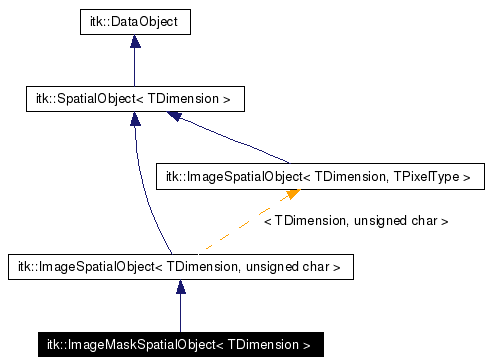
Inheritance diagram for itk::ImageMaskSpatialObject< TDimension >:
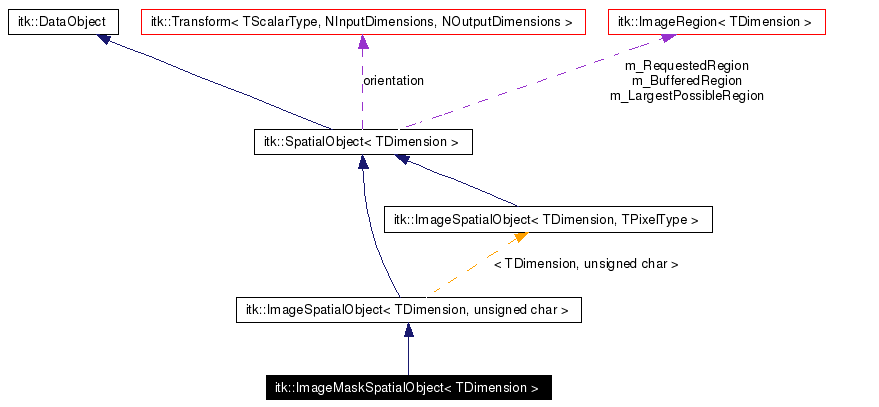
This class derives from the ImageSpatialObject and overloads the IsInside() method. One of the common uses of this class is to serve as Mask for the Image Registration Metrics.
Definition at line 38 of file itkImageMaskSpatialObject.h.
Public Types | |
| typedef AffineGeometryFrameType::Pointer | AffineGeometryFramePointer |
| typedef AffineGeometryFrame< double, TDimension > | AffineGeometryFrameType |
| typedef BoundingBoxType::Pointer | BoundingBoxPointer |
| typedef Superclass::BoundingBoxType | BoundingBoxType |
| typedef ChildrenListType * | ChildrenListPointer |
| typedef std::list< Pointer > | ChildrenListType |
| typedef SmartPointer< const Self > | ConstPointer |
| typedef CovariantVector< ScalarType, TDimension > | CovariantVectorType |
| typedef Superclass::ImagePointer | ImagePointer |
| typedef Superclass::ImageType | ImageType |
| typedef Superclass::IndexType | IndexType |
| typedef IndexType::IndexValueType | IndexValueType |
| typedef Point< ScalarType, TDimension > | InputType |
| typedef Offset< TDimension > | OffsetType |
| typedef OffsetType::OffsetValueType | OffsetValueType |
| typedef OutputVectorType * | OutputVectorPointer |
| typedef CovariantVector< double, TDimension > | OutputVectorType |
| typedef Superclass::PixelType | PixelType |
| typedef PointContainerType::Pointer | PointContainerPointer |
| typedef VectorContainer< unsigned long, PointType > | PointContainerType |
| typedef SmartPointer< Self > | Pointer |
| typedef PointType * | PointPointer |
| typedef Superclass::PointType | PointType |
| typedef PropertyType::Pointer | PropertyPointer |
| typedef SpatialObjectProperty< float > | PropertyType |
| typedef Superclass::RegionType | RegionType |
| typedef Superclass::ScalarType | ScalarType |
| typedef ImageMaskSpatialObject< TDimension > | Self |
| typedef Size< TDimension > | SizeType |
| typedef itk::ImageSliceConstIteratorWithIndex< ImageType > | SliceIteratorType |
| typedef double * | SpacingType |
| typedef ImageSpatialObject< TDimension > | Superclass |
| typedef const TransformType * | TransformConstPointer |
| typedef TransformType::Pointer | TransformPointer |
| typedef Superclass::TransformType | TransformType |
| typedef SpatialObjectTreeNode< TDimension > | TreeNodeType |
| typedef VectorContainer< unsigned long int, PointType > | VectorContainerType |
| typedef VectorType * | VectorPointer |
| typedef Vector< ScalarType, TDimension > | VectorType |
Public Member Functions | |
| void | AddSpatialObject (Self *pointer) |
| virtual void | Clear (void) |
| *Compute an axis aligned bounding box for an object and its selected down to a specified depth After the *resulting bounding box is stored in this m_Bounds **By the bounding box children depth is meaning that *the bounding box for the object and all its recursive children is computed *This depth can be it is possible to *restrict the bounding box computation to objects of a specified *type or family of types The spatial objects included in the *computation are those whose typenames as their initial the string specified via then it is not included in the bounding box but its descendents that match the string are *included *virtual bool | ComputeBoundingBox () const |
| Compute the index of the pixel at a specified offset from the *beginning of the buffered region *IndexType | ComputeIndex (OffsetValueType offset) const |
| bool | ComputeLocalBoundingBox () const |
| void | ComputeObjectToParentTransform (void) |
| void | ComputeObjectToWorldTransform (void) |
| Compute an offset from the beginning of the buffer for a pixel *at the specified index *OffsetValueType | ComputeOffset (const IndexType &ind) const |
| virtual void | CopyInformation (const DataObject *data) |
| virtual void | DerivativeAt (const PointType &point, short unsigned int order, OutputVectorType &value, unsigned int depth=0, char *name=NULL) |
| Returns true if a point is inside the object provided *to make spatial objects compatible with spatial functions *and conditional iterators for defining regions of interest *bool | Evaluate (const PointType &point) const |
| Set Get the AffineGeometryFrame *virtual const AffineGeometryFrameType * | GetAffineGeometryFrame () |
| RegionType | GetAxisAlignedBoundingBoxRegion () const |
| virtual BoundingBoxType * | GetBoundingBox () const |
| virtual const unsigned int & | GetBoundingBoxChildrenDepth () |
| virtual const std::string & | GetBoundingBoxChildrenName () |
| virtual const RegionType & | GetBufferedRegion () const |
| virtual ChildrenListType * | GetChildren (unsigned int depth=0, char *name=NULL) const |
| virtual double | GetDefaultInsideValue () const |
| virtual double | GetDefaultOutsideValue () const |
| Get Set the ID *virtual const int & | GetId () |
| const ImageType * | GetImage (void) const |
| const TransformType * | GetIndexToObjectTransform (void) const |
| Transform points from the internal data coordinate system *of the and offset of the indices *TransformType * | GetIndexToObjectTransform (void) |
| virtual const TransformType * | GetIndexToWorldTransform () |
| virtual TransformType * | GetIndexToWorldTransform () |
| virtual const RegionType & | GetLargestPossibleRegion () const |
| unsigned int | GetMaximumDepth () |
| unsigned long | GetMTime (void) const |
| virtual const char * | GetNameOfClass () const |
| const TransformType * | GetNodeToParentNodeTransform (void) const |
| TransformType * | GetNodeToParentNodeTransform (void) |
| unsigned int | GetNumberOfChildren (unsigned int depth=0, char *name=NULL) const |
| unsigned int | GetObjectDimension (void) const |
| unsigned long | GetObjectMTime (void) const |
| const TransformType * | GetObjectToNodeTransform (void) const |
| Transforms points from the object specific physical space *to the physical space of its parent object *TransformType * | GetObjectToNodeTransform (void) |
| const TransformType * | GetObjectToParentTransform (void) const |
| TransformType * | GetObjectToParentTransform (void) |
| virtual const TransformType * | GetObjectToWorldTransform () |
| virtual TransformType * | GetObjectToWorldTransform () |
| simplifies the implementation of *some data accessing algorithms *const OffsetValueType * | GetOffsetTable () const |
| virtual Self * | GetParent (void) |
| virtual const Self * | GetParent (void) const |
| virtual const int & | GetParentId () |
| const char * | GetPixelType () |
| const PropertyType * | GetProperty (void) const |
| Returns a pointer to the property object applied to this class *PropertyType * | GetProperty (void) |
| virtual const RegionType & | GetRequestedRegion () const |
| int | GetSlicePosition (unsigned int dimension) |
| virtual const double * | GetSpacing () const |
| virtual std::string | GetSpatialObjectTypeAsString () const |
| unsigned long | GetTransformMTime (void) |
| virtual const TreeNodeType * | GetTreeNode () |
| Return a raw pointer to the node container *virtual TreeNodeType * | GetTreeNode () |
| virtual const char * | GetTypeName (void) const |
| unsigned long | GetWorldTransformMTime (void) |
| virtual bool | HasParent (void) const |
| bool | IsEvaluableAt (const PointType &point, unsigned int depth=0, char *name=NULL) const |
| virtual bool | IsInside (const PointType &point) const |
| bool | IsInside (const PointType &point, unsigned int depth, char *name) const |
| itkStaticConstMacro (ObjectDimension, unsigned int, TDimension) | |
| itkStaticConstMacro (MaximumDepth, unsigned int, 9999999) | |
| Transform points from the internal data coordinate system *of the | object (typically the indices of the image from which *the object was defined) to"physical"space(which accounts *for the spacing |
| void | RemoveSpatialObject (Self *object) |
| virtual bool | RequestedRegionIsOutsideOfTheBufferedRegion () |
| *Compute an axis aligned bounding box for an object and its selected down to a specified depth After the *resulting bounding box is stored in this m_Bounds **By the bounding box children depth is meaning that *the bounding box for the object and all its recursive children is computed *This depth can be | set (before calling ComputeBoundingBox) using *SetBoundingBoxChildrenDepth().**By calling SetBoundingBoxChildrenName() |
| virtual void | SetAffineGeometryFrame (AffineGeometryFrameType *_arg) |
| Set Get the depth at which the bounding box is computed *virtual void | SetBoundingBoxChildrenDepth (unsigned int _arg) |
| Set Get the name of the children to consider when computing the *bounding box *virtual void | SetBoundingBoxChildrenName (std::string _arg) |
| *Compute an axis aligned bounding box for an object and its selected down to a specified depth After the *resulting bounding box is stored in this m_Bounds **By the bounding box children depth is meaning that *the bounding box for the object and all its recursive children is computed *This depth can be it is possible to *restrict the bounding box computation to objects of a specified *type or family of types The spatial objects included in the *computation are those whose typenames as their initial the string specified via | SetBoundingBoxChildrenName ().*The root spatial object(on which the method is called) is not *treated specially.If its typename does not match the bounding *box children name |
| virtual void | SetBufferedRegion (const RegionType ®ion) |
| void | SetChildren (ChildrenListType &children) |
| virtual void | SetId (int _arg) |
| void | SetImage (const ImageType *image) |
| virtual void | SetLargestPossibleRegion (const RegionType ®ion) |
| These function are just calling the node container transforms *void | SetNodeToParentNodeTransform (TransformType *transform) |
| Transforms points from the object specific physical space *to the physical space of its parent object *void | SetObjectToParentTransform (TransformType *transform) |
| This defines the transformation from the global coordinate frame *By setting this the local transform is computed *void | SetObjectToWorldTransform (TransformType *transform) |
| void | SetParent (Self *parent) |
| Set Get the parent Identification number *virtual void | SetParentId (int _arg) |
| void | SetProperty (PropertyType *property) |
| virtual void | SetRequestedRegion (DataObject *data) |
| virtual void | SetRequestedRegion (const RegionType ®ion) |
| virtual void | SetRequestedRegionToLargestPossibleRegion () |
| void | SetSlicePosition (unsigned int dimension, int position) |
| void | SetSpacing (const double spacing[itkGetStaticConstMacro(ObjectDimension)]) |
| virtual void | SetTreeNode (TreeNodeType *_arg) |
| virtual void | Update (void) |
| virtual void | UpdateOutputInformation () |
| Set Get the default outside | value (ValueAt()) of the object.Default is 0.0 */virtual void SetDefaultOutsideValue(double _arg) |
| Set Get the default inside | value (ValueAt()) of the object.Default is 1.0 */virtual void SetDefaultInsideValue(double _arg) |
| bool | ValueAt (const PointType &point, double &value, unsigned int depth=0, char *name=NULL) const |
| virtual bool | VerifyRequestedRegion () |
Static Public Member Functions | |
| static Pointer | New () |
Public Attributes | |
| Get the offset table The offset table gives increments for *moving from one pixel to next in the current *etc This table if of because its *values are computed progressively | as: {1 |
| *Compute an axis aligned bounding box for an object and its selected * | children |
| Get the offset table The offset table gives increments for *moving from one pixel to next in the current | column |
| *Compute an axis aligned bounding box for an object and its selected down to a specified depth After the *resulting bounding box is stored in this m_Bounds **By the bounding box children depth is meaning that *the bounding box for the object and all its recursive children is computed *This depth can be it is possible to *restrict the bounding box computation to objects of a specified *type or family of types The spatial objects included in the *computation are those whose typenames as their initial the string specified via then it is not included in the bounding box * | computation |
| *Compute an axis aligned bounding box for an object and its selected down to a specified depth After | computation |
| *Compute an axis aligned bounding box for an object and its selected down to a specified depth After the *resulting bounding box is stored in this m_Bounds **By | default |
| *Compute an axis aligned bounding box for an object and its selected down to a specified depth After the *resulting bounding box is stored in this m_Bounds **By the bounding box children depth is | maximum |
| Get the offset table The offset table gives increments for *moving from one pixel to next in the current *etc This table if of because its *values are computed progressively | N1 |
| Get the offset table The offset table gives increments for *moving from one pixel to next in the current *etc This table if of because its *values are computed progressively N1 * | N2 |
| Get the offset table The offset table gives increments for *moving from one pixel to next in the current *etc This table if of because its *values are computed progressively N1 *N1 *N2 * | N3 |
| Transform points from the internal data coordinate system *of the | orientation |
| Get the offset table The offset table gives increments for *moving from one pixel to next in the current | row |
| *Compute an axis aligned bounding box for an object and its selected down to a specified depth After the *resulting bounding box is stored in this m_Bounds **By the bounding box children depth is meaning that *the bounding box for the object and all its recursive children is computed *This depth can be it is possible to *restrict the bounding box computation to objects of a specified *type or family of types The spatial objects included in the *computation are those whose typenames | share |
| Get the offset table The offset table gives increments for *moving from one pixel to next in the current *etc This table if of | size [VImageDimension+1] |
| Get the offset table The offset table gives increments for *moving from one pixel to next in the current | slice |
| *Compute an axis aligned bounding box for an object and its selected down to a specified depth After the *resulting bounding box is stored in this m_Bounds **By the bounding box children depth is meaning that *the bounding box for the object and all its recursive children is computed *This depth can be it is possible to *restrict the bounding box computation to objects of a specified *type or family of types The spatial objects included in the *computation are those whose typenames as their initial * | substring |
| This defines the transformation from the global coordinate frame *By setting this | transform |
Protected Member Functions | |
| void | ComputeOffsetTable () |
| virtual const BoundingBoxType * | GetBounds () |
| virtual const unsigned int & | GetDimension () |
| virtual const TransformType * | GetInternalInverseTransform () |
| ImageMaskSpatialObject () | |
| ImageSpatialObject () | |
| void | PrintSelf (std::ostream &os, Indent indent) const |
| virtual void | SetDimension (unsigned int _arg) |
| virtual void | SetTypeName (std::string _arg) |
| virtual | ~ImageMaskSpatialObject () |
Protected Attributes | |
| ImagePointer | m_Image |
| std::string | m_PixelType |
| int * | m_SlicePosition |
|
|||||
|
Definition at line 115 of file itkSpatialObject.h. |
|
|||||
|
Definition at line 114 of file itkSpatialObject.h. |
|
|||||
|
Definition at line 112 of file itkSpatialObject.h. |
|
|||||
|
Reimplemented from itk::ImageSpatialObject< TDimension, unsigned char >. Definition at line 57 of file itkImageMaskSpatialObject.h. |
|
|||||
|
Definition at line 119 of file itkSpatialObject.h. |
|
|||||
|
Return type for the list of children Reimplemented in itk::PolygonGroupSpatialObject< TDimension >. Definition at line 118 of file itkSpatialObject.h. |
|
|||||
|
Reimplemented from itk::ImageSpatialObject< TDimension, unsigned char >. Definition at line 47 of file itkImageMaskSpatialObject.h. |
|
|||||
|
|||||
|
Reimplemented from itk::ImageSpatialObject< TDimension, unsigned char >. Definition at line 52 of file itkImageMaskSpatialObject.h. |
|
|||||
|
Reimplemented from itk::ImageSpatialObject< TDimension, unsigned char >. Definition at line 51 of file itkImageMaskSpatialObject.h. |
|
|||||
|
Index typedef support. An index is used to access pixel values. Reimplemented from itk::ImageSpatialObject< TDimension, unsigned char >. Definition at line 53 of file itkImageMaskSpatialObject.h. |
|
|||||
|
Definition at line 124 of file itkSpatialObject.h. |
|
|||||
|
Definition at line 92 of file itkSpatialObject.h. |
|
|||||
|
Offset typedef support. An offset represent relative position between indices. Definition at line 128 of file itkSpatialObject.h. |
|
|||||
|
Definition at line 129 of file itkSpatialObject.h. |
|
|||||
|
Definition at line 102 of file itkSpatialObject.h. |
|
|||||
|
Definition at line 101 of file itkSpatialObject.h. |
|
|||||
|
Reimplemented from itk::ImageSpatialObject< TDimension, unsigned char >. Definition at line 50 of file itkImageMaskSpatialObject.h. |
|
|
Definition at line 62 of file itkImageSpatialObject.h. |
|
|
Definition at line 61 of file itkImageSpatialObject.h. |
|
|||||
|
Reimplemented from itk::ImageSpatialObject< TDimension, unsigned char >. Definition at line 46 of file itkImageMaskSpatialObject.h. |
|
|||||
|
Definition at line 93 of file itkSpatialObject.h. |
|
|||||
|
Reimplemented from itk::ImageSpatialObject< TDimension, unsigned char >. Definition at line 56 of file itkImageMaskSpatialObject.h. |
|
|||||
|
Definition at line 133 of file itkSpatialObject.h. |
|
|||||
|
Definition at line 132 of file itkSpatialObject.h. |
|
|||||
|
Reimplemented from itk::ImageSpatialObject< TDimension, unsigned char >. Definition at line 54 of file itkImageMaskSpatialObject.h. |
|
|||||
|
Reimplemented from itk::ImageSpatialObject< TDimension, unsigned char >. Definition at line 49 of file itkImageMaskSpatialObject.h. |
|
|||||
|
Reimplemented from itk::ImageSpatialObject< TDimension, unsigned char >. Definition at line 44 of file itkImageMaskSpatialObject.h. |
|
|||||
|
Reimplemented in itk::BoxSpatialObject< TDimension >. Definition at line 131 of file itkSpatialObject.h. |
|
|||||
|
Definition at line 60 of file itkImageMaskSpatialObject.h. |
|
|||||
|
Definition at line 99 of file itkSpatialObject.h. |
|
|||||
|
Reimplemented from itk::ImageSpatialObject< TDimension, unsigned char >. Definition at line 45 of file itkImageMaskSpatialObject.h. |
|
|||||
|
Definition at line 106 of file itkSpatialObject.h. |
|
|||||
|
Definition at line 105 of file itkSpatialObject.h. |
|
|||||
|
Reimplemented from itk::ImageSpatialObject< TDimension, unsigned char >. Definition at line 55 of file itkImageMaskSpatialObject.h. |
|
|||||
|
Reimplemented in itk::GroupSpatialObject< TDimension >, and itk::PolygonGroupSpatialObject< TDimension >. Definition at line 135 of file itkSpatialObject.h. |
|
|||||
|
Definition at line 108 of file itkSpatialObject.h. |
|
|||||
|
Definition at line 97 of file itkSpatialObject.h. |
|
|||||
|
|||||||||
|
|
|
|||||||||
|
|
|
||||||||||
|
Add an object to the list of children. |
|
||||||||||
|
Clear the spatial object by deleting all lists of children and subchildren Reimplemented in itk::TubeSpatialObject< TDimension, TTubePointType >, itk::TubeSpatialObject< TDimension, VesselTubeSpatialObjectPoint< TDimension > >, and itk::TubeSpatialObject< TDimension, DTITubeSpatialObjectPoint< TDimension > >. |
|
|||||||||
|
|
|
||||||||||
|
Definition at line 316 of file itkSpatialObject.h. |
|
|
Compute the boundaries of the iamge spatial object. Reimplemented from itk::SpatialObject< TDimension >. |
|
||||||||||
|
Compute the Local transform when the global transform is set |
|
||||||||||
|
Compute the World transform when the local transform is set This function should be called each time the local transform has been modified |
|
||||||||||
|
Definition at line 296 of file itkSpatialObject.h. |
|
|||||||||
|
Calculate the offsets needed to move from one pixel to the next along a row, column, slice, volume, etc. These offsets are based on the size of the BufferedRegion. This should be called after the BufferedRegion is set. |
|
||||||||||
|
Copy information from the specified data set. This method is part of the pipeline execution model. By default, a ProcessObject will copy meta-data from the first input to all of its outputs. See ProcessObject::GenerateOutputInformation(). Each subclass of DataObject is responsible for being able to copy whatever meta-data it needs from from another DataObject. ImageBase has more meta-data than its DataObject. Thus, it must provide its own version of CopyInformation() in order to copy the LargestPossibleRegion from the input parameter. Reimplemented in itk::EllipseSpatialObject< TDimension >, itk::TubeSpatialObject< TDimension, TTubePointType >, itk::TubeSpatialObject< TDimension, VesselTubeSpatialObjectPoint< TDimension > >, and itk::TubeSpatialObject< TDimension, DTITubeSpatialObjectPoint< TDimension > >. |
|
||||||||||||||||||||||||||||
|
Return the n-th order derivative value at the specified point. |
|
||||||||||
|
Definition at line 210 of file itkSpatialObject.h. |
|
|||||||||
|
|
|
|||||||||
|
Compute axis aligned bounding box from the image mask. The bounding box is returned as an image region. Each call to this function will recompute the region. This function is useful in cases, where you may have a mask image resulting from say a segmentation and you want to get the smallest box region that encapsulates the mask image. Currently this is done only for 3D volumes. |
|
|||||||||
|
Get the bounding box of the object. This function calls ComputeBoundingBox() |
|
|||||||||
|
|
|
|||||||||
|
|
|
|||||||||
|
|
|
|||||||||
|
Get the region object that defines the size and starting index of the region of the image currently loaded in memory. Definition at line 260 of file itkSpatialObject.h. |
|
||||||||||||||||
|
Returns a list of pointer to the children affiliated to this object. A depth of 0 returns the immediate childred. A depth of 1 returns the children and those children's children.
|
|
|||||||||
|
|
|
|||||||||
|
|
|
|||||||||
|
|
|
|||||||||
|
|
|
|
Get a pointer to the image currently attached to the object. |
|
||||||||||
|
|
|
||||||||||
|
Referenced by itk::SpatialObject< ::itk::GetMeshDimension< TMesh >::PointDimension >::GetSpacing(), and itk::SpatialObject< ::itk::GetMeshDimension< TMesh >::PointDimension >::SetSpacing(). |
|
|||||||||
|
|
|
|||||||||
|
|
|
|||||||||
|
|
|
|||||||||
|
Get the region object that defines the size and starting index for the largest possible region this image could represent. This is used in determining how much memory would be needed to load an entire dataset. It is also used to determine boundary conditions.
Definition at line 249 of file itkSpatialObject.h. |
|
|||||||||
|
Return the maximum depth that a tree of spatial objects can have. This provides convenient access to a static constant. Definition at line 82 of file itkSpatialObject.h. |
|
|
Returns the latest modified time of the object and its component. Reimplemented from itk::SpatialObject< TDimension >. |
|
|||||||||
|
Run-time type information (and related methods). Reimplemented from itk::ImageSpatialObject< TDimension, unsigned char >. |
|
||||||||||
|
|
|
||||||||||
|
|
|
||||||||||||||||
|
Returns the number of children currently assigned to the object. |
|
||||||||||
|
Get the dimensionality of the object Definition at line 150 of file itkSpatialObject.h. |
|
||||||||||
|
Returns the latest modified time of the spatial object, but not the modification time of the children Definition at line 230 of file itkSpatialObject.h. |
|
||||||||||
|
|
|
||||||||||
|
|
|
||||||||||
|
|
|
||||||||||
|
|
|
|||||||||
|
|
|
|||||||||
|
|
|
|||||||||
|
Definition at line 291 of file itkSpatialObject.h. |
|
||||||||||
|
Return a pointer to the parent object in the hierarchy tree |
|
||||||||||
|
Return a pointer to the parent object in the hierarchy tree |
|
|||||||||
|
|
|
|
Definition at line 110 of file itkImageSpatialObject.h. References itk::ImageSpatialObject< TDimension, TPixelType >::m_PixelType. |
|
||||||||||
|
Definition at line 382 of file itkSpatialObject.h. |
|
||||||||||
|
|
|
|||||||||
|
Get the region object that defines the size and starting index for the region of the image requested (i.e., the region of the image to be operated on by a filter). Definition at line 279 of file itkSpatialObject.h. |
|
|
Get the slice position Definition at line 107 of file itkImageSpatialObject.h. References itk::ImageSpatialObject< TDimension, TPixelType >::m_SlicePosition. |
|
|||||||||
|
Get the spacing of the spatial object. Definition at line 417 of file itkSpatialObject.h. |
|
|||||||||
|
Return the type of the spatial object as a string This is used by the SpatialObjectFactory |
|
||||||||||
|
Return the Modified time of the LocalToWorldTransform |
|
|||||||||
|
|
|
|||||||||
|
|
|
||||||||||
|
Get the typename of the SpatialObject Definition at line 142 of file itkSpatialObject.h. |
|
||||||||||
|
Return the Modified time of the WorldToLocalTransform |
|
||||||||||
|
Return true if the object has a parent object. Basically, only the root object , or some isolated objects should return false. |
|
|
|
|
||||||||||||||||
|
Return true if the object is evaluable at the requested point, and else otherwise. Reimplemented from itk::SpatialObject< TDimension >. |
|
||||||||||
|
Test whether a point is inside or outside the object For computational speed purposes, it is faster if the method does not check the name of the class and the current depth Reimplemented from itk::ImageSpatialObject< TDimension, unsigned char >. |
|
||||||||||||||||||||
|
Returns true if the point is inside, false otherwise. Reimplemented from itk::ImageSpatialObject< TDimension, unsigned char >. |
|
||||||||||||||||||||
|
Dimension of the object. This constant is used by functions that are templated over SpatialObject type when they need compile time access to the dimension of the object. |
|
||||||||||||||||||||
|
|
|
|||||||||
|
Method for creation through the object factory. Reimplemented from itk::ImageSpatialObject< TDimension, unsigned char >. |
|
||||||||||
|
|
|
||||||||||||||||
|
Reimplemented from itk::ImageSpatialObject< TDimension, unsigned char >. |
|
||||||||||
|
Remove the object passed as arguments from the list of children. May this function should return a false value if the object to remove is not found in the list. |
|
|||||||||
|
Determine whether the RequestedRegion is outside of the BufferedRegion. This method returns true if the RequestedRegion is outside the BufferedRegion (true if at least one pixel is outside). This is used by the pipeline mechanism to determine whether a filter needs to re-execute in order to satisfy the current request. If the current RequestedRegion is already inside the BufferedRegion from the previous execution (and the current filter is up to date), then a given filter does not need to re-execute |
|
||||||||||
|
|
|
||||||||||
|
|
|
||||||||||
|
|
|
||||||||||
|
|
|
|||||||||
|
|
|
||||||||||
|
Set the region object that defines the size and starting index of the region of the image currently loaded in memory. |
|
||||||||||
|
Set the list of pointers to children to the list passed as argument. |
|
||||||||||
|
|
|
||||||||||
|
|
|
|
Set the image. |
|
||||||||||
|
Set the region object that defines the size and starting index for the largest possible region this image could represent. This is used in determining how much memory would be needed to load an entire dataset. It is also used to determine boundary conditions.
|
|
||||||||||
|
|
|
||||||||||
|
|
|
||||||||||
|
|
|
||||||||||
|
Set the pointer to the parent object in the tree hierarchy used for the spatial object patter. |
|
||||||||||
|
|
|
||||||||||
|
Set the property applied to the object. |
|
||||||||||
|
Set the requested region from this data object to match the requested region of the data object passed in as a parameter. This method implements the API from DataObject. The data object parameter must be castable to an ImageBase. |
|
||||||||||
|
Set the region object that defines the size and starting index for the region of the image requested (i.e., the region of the image to be operated on by a filter). |
|
|||||||||
|
Set the RequestedRegion to the LargestPossibleRegion. This forces a filter to produce all of the output in one execution (i.e. not streaming) on the next call to Update(). |
|
||||||||||||
|
Set the slice position |
|
||||||||||
|
Set the spacing of the spatial object. Definition at line 412 of file itkSpatialObject.h. |
|
||||||||||
|
Set the tree container Referenced by itk::SpatialObjectTreeNode< TDimension >::SetData(). |
|
||||||||||
|
|
|
||||||||||
|
Specify that the object has been updated |
|
|||||||||
|
Update the information for this DataObject so that it can be used as an output of a ProcessObject. This method is used the pipeline mechanism to propagate information and initialize the meta data associated with a DataObject. This method calls its source's ProcessObject::UpdateOutputInformation() which determines modified times, LargestPossibleRegions, and any extra meta data like spacing, origin, etc. |
|
||||||||||
|
|
|
||||||||||
|
|
|
||||||||||||||||||||
|
Returns the value of the image at the requested point. If the point is not inside the object, then an exception is thrown.
Reimplemented from itk::SpatialObject< TDimension >. |
|
|||||||||
|
Verify that the RequestedRegion is within the LargestPossibleRegion. If the RequestedRegion is not within the LargestPossibleRegion, then the filter cannot possible satisfy the request. This method returns true if the request can be satisfied and returns fails if the request cannot. This method is used by PropagateRequestedRegion(). PropagateRequestedRegion() throws a InvalidRequestedRegionError exception is the requested region is not within the LargestPossibleRegion. |
|
|||||
|
Definition at line 280 of file itkSpatialObject.h. |
|
|||||
|
Definition at line 484 of file itkSpatialObject.h. |
|
|||||
|
Definition at line 280 of file itkSpatialObject.h. |
|
|||||
|
Definition at line 500 of file itkSpatialObject.h. |
|
|||||
|
Definition at line 484 of file itkSpatialObject.h. |
|
|||||
|
Definition at line 484 of file itkSpatialObject.h. |
|
|
Definition at line 117 of file itkImageSpatialObject.h. |
|
|
Definition at line 125 of file itkImageSpatialObject.h. |
|
|
Definition at line 124 of file itkImageSpatialObject.h. |
|
|||||
|
Definition at line 484 of file itkSpatialObject.h. |
|
|||||
|
Definition at line 280 of file itkSpatialObject.h. |
|
|||||
|
Definition at line 280 of file itkSpatialObject.h. |
|
|||||
|
Definition at line 280 of file itkSpatialObject.h. |
|
|||||
|
Definition at line 424 of file itkSpatialObject.h. |
|
|||||
|
Definition at line 280 of file itkSpatialObject.h. |
|
|||||
|
Definition at line 495 of file itkSpatialObject.h. |
|
|||||
|
Definition at line 280 of file itkSpatialObject.h. |
|
|||||
|
Definition at line 280 of file itkSpatialObject.h. |
|
|||||
|
Definition at line 495 of file itkSpatialObject.h. |
|
|||||
|
Definition at line 160 of file itkSpatialObject.h. |
 1.4.2 written by Dimitri van Heesch,
© 1997-2000
1.4.2 written by Dimitri van Heesch,
© 1997-2000