Main Page   Groups   Namespace List   Class Hierarchy   Alphabetical List   Compound List   File List   Namespace Members   Compound Members   File Members   Concepts

itk::SpatialObject< TDimension > Class Template Reference

#include <itkSpatialObject.h>

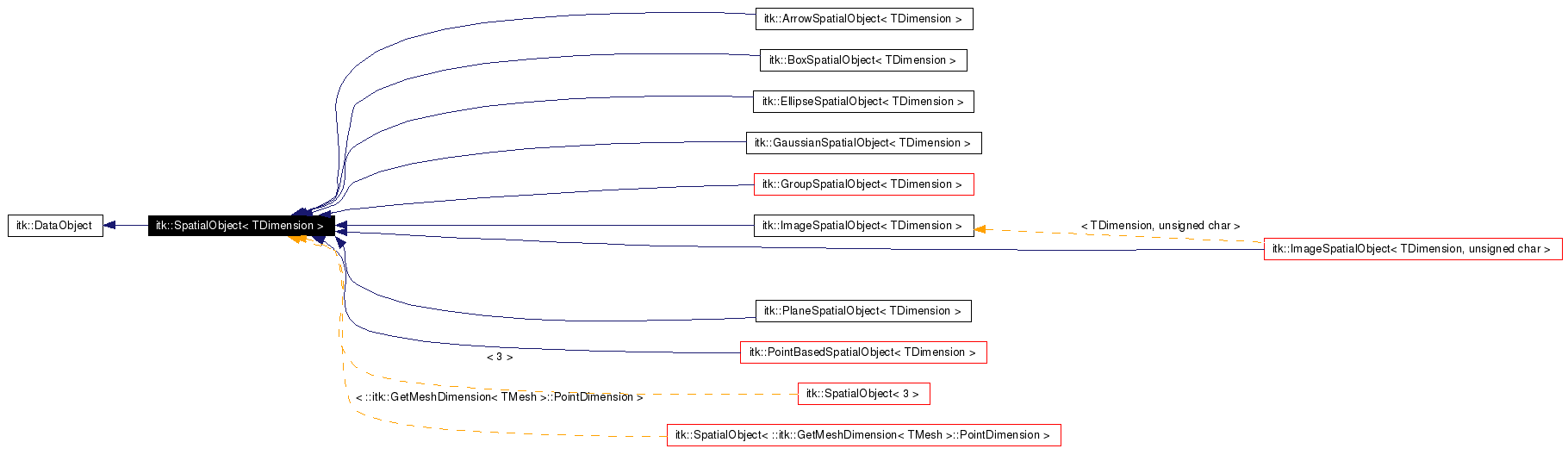
Inheritance diagram for itk::SpatialObject< TDimension >:

Inheritance graph
[legend]
Collaboration diagram for itk::SpatialObject< TDimension >:

Collaboration graph
[legend]
List of all members.

Detailed Description

template<unsigned int TDimension = 3>
class itk::SpatialObject< TDimension >

Implementation of the composite pattern.

The purpose of this class is to implement the composite pattern [Design Patterns, Gamma, 1995] within itk, so that it becomes easy to create an environment containing objects within a scene, and to manipulate the environment as a whole or any of its component objects. An object has a list of transformations to transform index coordinates to the corresponding coordinates in the real world coordinate system, and a list of inverse transformation to go backward. Any spatial objects can be plugged to a spatial object as children. To implement your own spatial object, you need to derive from the following class, which requires the definition of just a few pure virtual functions. Examples of such functions are ValueAt(), IsEvaluableAt(), and IsInside(), each of which has a meaning specific to each particular object type.

Definition at line 70 of file itkSpatialObject.h.

Public Types

typedef AffineGeometryFrameType::Pointer AffineGeometryFramePointer
typedef AffineGeometryFrame<
double, TDimension > 
AffineGeometryFrameType
typedef BoundingBoxType::Pointer BoundingBoxPointer
typedef BoundingBox< unsigned
long int, TDimension, ScalarType,
VectorContainerType
BoundingBoxType
typedef ChildrenListTypeChildrenListPointer
typedef std::list< PointerChildrenListType
typedef SmartPointer< const
Self
ConstPointer
typedef CovariantVector< ScalarType,
TDimension > 
CovariantVectorType
typedef Index< TDimension > IndexType
typedef IndexType::IndexValueType IndexValueType
typedef Point< ScalarType,
TDimension > 
InputType
typedef Offset< TDimension > OffsetType
typedef OffsetType::OffsetValueType OffsetValueType
typedef OutputVectorTypeOutputVectorPointer
typedef CovariantVector< double,
TDimension > 
OutputVectorType
typedef SmartPointer< SelfPointer
typedef PointTypePointPointer
typedef Point< ScalarType,
TDimension > 
PointType
typedef PropertyType::Pointer PropertyPointer
typedef SpatialObjectProperty<
float > 
PropertyType
typedef ImageRegion< TDimension > RegionType
typedef double ScalarType
typedef SpatialObject< TDimension > Self
typedef Size< TDimension > SizeType
typedef double * SpacingType
typedef DataObject Superclass
typedef const TransformTypeTransformConstPointer
typedef TransformType::Pointer TransformPointer
typedef ScalableAffineTransform<
double, TDimension > 
TransformType
typedef SpatialObjectTreeNode<
TDimension > 
TreeNodeType
typedef VectorContainer< unsigned
long int, PointType
VectorContainerType
typedef VectorTypeVectorPointer
typedef Vector< ScalarType,
TDimension > 
VectorType

Public Member Functions

void AddSpatialObject (Self *pointer)
virtual void Clear (void)
*Compute an axis aligned bounding
box for an object and its
selected down to a specified
depth After the *resulting
bounding box is stored in
this m_Bounds **By the bounding
box children depth is meaning
that *the bounding box for
the object and all its recursive
children is computed *This
depth can be it is possible
to *restrict the bounding
box computation to objects
of a specified *type or family
of types The spatial objects
included in the *computation
are those whose typenames
as their initial the string
specified via then it is not
included in the bounding box
but its descendents that match
the string are *included
*virtual bool 
ComputeBoundingBox () const
Compute the index of the pixel
at a specified offset from
the *beginning of the buffered
region *IndexType 
ComputeIndex (OffsetValueType offset) const
virtual bool ComputeLocalBoundingBox () const
void ComputeObjectToParentTransform (void)
void ComputeObjectToWorldTransform (void)
Compute an offset from the
beginning of the buffer for
a pixel *at the specified
index *OffsetValueType 
ComputeOffset (const IndexType &ind) const
virtual void CopyInformation (const DataObject *data)
virtual void DerivativeAt (const PointType &point, short unsigned int order, OutputVectorType &value, unsigned int depth=0, char *name=NULL)
Returns true if a point is
inside the object provided
*to make spatial objects compatible
with spatial functions *and
conditional iterators for
defining regions of interest
*bool 
Evaluate (const PointType &point) const
Set Get the AffineGeometryFrame
*virtual const AffineGeometryFrameType
GetAffineGeometryFrame ()
virtual BoundingBoxTypeGetBoundingBox () const
virtual const unsigned int & GetBoundingBoxChildrenDepth ()
virtual const std::string & GetBoundingBoxChildrenName ()
virtual const RegionTypeGetBufferedRegion () const
virtual ChildrenListTypeGetChildren (unsigned int depth=0, char *name=NULL) const
virtual double GetDefaultInsideValue () const
virtual double GetDefaultOutsideValue () const
Get Set the ID *virtual const
int & 
GetId ()
const TransformTypeGetIndexToObjectTransform (void) const
Transform points from the
internal data coordinate system
*of the and offset of the
indices *TransformType
GetIndexToObjectTransform (void)
virtual const TransformTypeGetIndexToWorldTransform ()
virtual TransformTypeGetIndexToWorldTransform ()
virtual const RegionTypeGetLargestPossibleRegion () const
unsigned int GetMaximumDepth ()
unsigned long GetMTime (void) const
virtual const char * GetNameOfClass () const
const TransformTypeGetNodeToParentNodeTransform (void) const
TransformTypeGetNodeToParentNodeTransform (void)
unsigned int GetNumberOfChildren (unsigned int depth=0, char *name=NULL) const
unsigned int GetObjectDimension (void) const
unsigned long GetObjectMTime (void) const
const TransformTypeGetObjectToNodeTransform (void) const
Transforms points from the
object specific physical space
*to the physical space of
its parent object *TransformType
GetObjectToNodeTransform (void)
const TransformTypeGetObjectToParentTransform (void) const
TransformTypeGetObjectToParentTransform (void)
virtual const TransformTypeGetObjectToWorldTransform ()
virtual TransformTypeGetObjectToWorldTransform ()
simplifies the implementation
of *some data accessing algorithms
*const OffsetValueType
GetOffsetTable () const
virtual SelfGetParent (void)
virtual const SelfGetParent (void) const
virtual const int & GetParentId ()
const PropertyTypeGetProperty (void) const
Returns a pointer to the property
object applied to this class
*PropertyType
GetProperty (void)
virtual const RegionTypeGetRequestedRegion () const
virtual const double * GetSpacing () const
virtual std::string GetSpatialObjectTypeAsString () const
unsigned long GetTransformMTime (void)
virtual const TreeNodeTypeGetTreeNode ()
Return a raw pointer to the
node container *virtual TreeNodeType
GetTreeNode ()
virtual const char * GetTypeName (void) const
unsigned long GetWorldTransformMTime (void)
virtual bool HasParent (void) const
virtual bool IsEvaluableAt (const PointType &point, unsigned int depth=0, char *name=NULL) const
virtual bool IsInside (const PointType &point, unsigned int depth=0, char *name=NULL) const
 itkStaticConstMacro (ObjectDimension, unsigned int, TDimension)
 itkStaticConstMacro (MaximumDepth, unsigned int, 9999999)
Transform points from the
internal data coordinate system
*of the 
object (typically the indices of the image from which *the object was defined) to"physical"space(which accounts *for the spacing
void RemoveSpatialObject (Self *object)
virtual bool RequestedRegionIsOutsideOfTheBufferedRegion ()
*Compute an axis aligned bounding
box for an object and its
selected down to a specified
depth After the *resulting
bounding box is stored in
this m_Bounds **By the bounding
box children depth is meaning
that *the bounding box for
the object and all its recursive
children is computed *This
depth can be 
set (before calling ComputeBoundingBox) using *SetBoundingBoxChildrenDepth().**By calling SetBoundingBoxChildrenName()
virtual void SetAffineGeometryFrame (AffineGeometryFrameType *_arg)
Set Get the depth at which
the bounding box is computed
*virtual void 
SetBoundingBoxChildrenDepth (unsigned int _arg)
Set Get the name of the children
to consider when computing
the *bounding box *virtual
void 
SetBoundingBoxChildrenName (std::string _arg)
*Compute an axis aligned bounding
box for an object and its
selected down to a specified
depth After the *resulting
bounding box is stored in
this m_Bounds **By the bounding
box children depth is meaning
that *the bounding box for
the object and all its recursive
children is computed *This
depth can be it is possible
to *restrict the bounding
box computation to objects
of a specified *type or family
of types The spatial objects
included in the *computation
are those whose typenames
as their initial the string
specified via 
SetBoundingBoxChildrenName ().*The root spatial object(on which the method is called) is not *treated specially.If its typename does not match the bounding *box children name
virtual void SetBufferedRegion (const RegionType &region)
void SetChildren (ChildrenListType &children)
virtual void SetId (int _arg)
virtual void SetLargestPossibleRegion (const RegionType &region)
These function are just calling
the node container transforms
*void 
SetNodeToParentNodeTransform (TransformType *transform)
Transforms points from the
object specific physical space
*to the physical space of
its parent object *void 
SetObjectToParentTransform (TransformType *transform)
This defines the transformation
from the global coordinate
frame *By setting this the
local transform is computed
*void 
SetObjectToWorldTransform (TransformType *transform)
void SetParent (Self *parent)
Set Get the parent Identification
number *virtual void 
SetParentId (int _arg)
void SetProperty (PropertyType *property)
virtual void SetRequestedRegion (DataObject *data)
virtual void SetRequestedRegion (const RegionType &region)
virtual void SetRequestedRegionToLargestPossibleRegion ()
void SetSpacing (const double spacing[itkGetStaticConstMacro(ObjectDimension)])
virtual void SetTreeNode (TreeNodeType *_arg)
virtual void Update (void)
virtual void UpdateOutputInformation ()
Set Get the default outside value (ValueAt()) of the object.Default is 0.0 */virtual void SetDefaultOutsideValue(double _arg)
Set Get the default inside value (ValueAt()) of the object.Default is 1.0 */virtual void SetDefaultInsideValue(double _arg)
virtual bool ValueAt (const PointType &point, double &value, unsigned int depth=0, char *name=NULL) const
virtual bool VerifyRequestedRegion ()

Static Public Member Functions

static Pointer New ()

Public Attributes

Get the offset table The offset
table gives increments for
*moving from one pixel to
next in the current *etc This
table if of because its *values
are computed progressively 
as: {1
*Compute an axis aligned bounding
box for an object and its
selected * 
children
Get the offset table The offset
table gives increments for
*moving from one pixel to
next in the current 
column
*Compute an axis aligned bounding
box for an object and its
selected down to a specified
depth After the *resulting
bounding box is stored in
this m_Bounds **By the bounding
box children depth is meaning
that *the bounding box for
the object and all its recursive
children is computed *This
depth can be it is possible
to *restrict the bounding
box computation to objects
of a specified *type or family
of types The spatial objects
included in the *computation
are those whose typenames
as their initial the string
specified via then it is not
included in the bounding box * 
computation
*Compute an axis aligned bounding
box for an object and its
selected down to a specified
depth After 
computation
*Compute an axis aligned bounding
box for an object and its
selected down to a specified
depth After the *resulting
bounding box is stored in
this m_Bounds **By 
default
*Compute an axis aligned bounding
box for an object and its
selected down to a specified
depth After the *resulting
bounding box is stored in
this m_Bounds **By the bounding
box children depth is 
maximum
Get the offset table The offset
table gives increments for
*moving from one pixel to
next in the current *etc This
table if of because its *values
are computed progressively 
N1
Get the offset table The offset
table gives increments for
*moving from one pixel to
next in the current *etc This
table if of because its *values
are computed progressively
N1
N2
Get the offset table The offset
table gives increments for
*moving from one pixel to
next in the current *etc This
table if of because its *values
are computed progressively
N1 *N1 *N2
N3
Transform points from the
internal data coordinate system
*of the 
orientation
Get the offset table The offset
table gives increments for
*moving from one pixel to
next in the current 
row
*Compute an axis aligned bounding
box for an object and its
selected down to a specified
depth After the *resulting
bounding box is stored in
this m_Bounds **By the bounding
box children depth is meaning
that *the bounding box for
the object and all its recursive
children is computed *This
depth can be it is possible
to *restrict the bounding
box computation to objects
of a specified *type or family
of types The spatial objects
included in the *computation
are those whose typenames 
share
Get the offset table The offset
table gives increments for
*moving from one pixel to
next in the current *etc This
table if of 
size [VImageDimension+1]
Get the offset table The offset
table gives increments for
*moving from one pixel to
next in the current 
slice
*Compute an axis aligned bounding
box for an object and its
selected down to a specified
depth After the *resulting
bounding box is stored in
this m_Bounds **By the bounding
box children depth is meaning
that *the bounding box for
the object and all its recursive
children is computed *This
depth can be it is possible
to *restrict the bounding
box computation to objects
of a specified *type or family
of types The spatial objects
included in the *computation
are those whose typenames
as their initial * 
substring
This defines the transformation
from the global coordinate
frame *By setting this 
transform

Protected Member Functions

void ComputeOffsetTable ()
virtual const BoundingBoxTypeGetBounds ()
virtual const unsigned int & GetDimension ()
virtual const TransformTypeGetInternalInverseTransform ()
virtual void PrintSelf (std::ostream &os, Indent indent) const
virtual void SetDimension (unsigned int _arg)
virtual void SetTypeName (std::string _arg)
 SpatialObject ()
virtual ~SpatialObject ()


Member Typedef Documentation

template<unsigned int TDimension = 3>
typedef AffineGeometryFrameType::Pointer itk::SpatialObject< TDimension >::AffineGeometryFramePointer
 

Definition at line 115 of file itkSpatialObject.h.

template<unsigned int TDimension = 3>
typedef AffineGeometryFrame<double,TDimension> itk::SpatialObject< TDimension >::AffineGeometryFrameType
 

Definition at line 114 of file itkSpatialObject.h.

template<unsigned int TDimension = 3>
typedef BoundingBoxType::Pointer itk::SpatialObject< TDimension >::BoundingBoxPointer
 

Definition at line 112 of file itkSpatialObject.h.

template<unsigned int TDimension = 3>
typedef BoundingBox< unsigned long int, TDimension, ScalarType, VectorContainerType > itk::SpatialObject< TDimension >::BoundingBoxType
 

Reimplemented in itk::BlobSpatialObject< TDimension >, itk::BoxSpatialObject< TDimension >, itk::ContourSpatialObject< TDimension >, itk::CylinderSpatialObject, itk::DTITubeSpatialObject< TDimension >, itk::EllipseSpatialObject< TDimension >, itk::GaussianSpatialObject< TDimension >, itk::ImageMaskSpatialObject< TDimension >, itk::ImageSpatialObject< TDimension, TPixelType >, itk::LandmarkSpatialObject< TDimension >, itk::LineSpatialObject< TDimension >, itk::MeshSpatialObject< TMesh >, itk::PlaneSpatialObject< TDimension >, itk::PolygonGroupSpatialObject< TDimension >, itk::SurfaceSpatialObject< TDimension >, itk::TubeSpatialObject< TDimension, TTubePointType >, itk::VesselTubeSpatialObject< TDimension >, itk::ImageSpatialObject< TDimension, unsigned char >, itk::TubeSpatialObject< TDimension, VesselTubeSpatialObjectPoint< TDimension > >, and itk::TubeSpatialObject< TDimension, DTITubeSpatialObjectPoint< TDimension > >.

Definition at line 111 of file itkSpatialObject.h.

template<unsigned int TDimension = 3>
typedef ChildrenListType* itk::SpatialObject< TDimension >::ChildrenListPointer
 

Definition at line 119 of file itkSpatialObject.h.

template<unsigned int TDimension = 3>
typedef std::list< Pointer > itk::SpatialObject< TDimension >::ChildrenListType
 

Return type for the list of children

Reimplemented in itk::PolygonGroupSpatialObject< TDimension >.

Definition at line 118 of file itkSpatialObject.h.

template<unsigned int TDimension = 3>
typedef SmartPointer< const Self > itk::SpatialObject< TDimension >::ConstPointer
 

Reimplemented in itk::ArrowSpatialObject< TDimension >, itk::BlobSpatialObject< TDimension >, itk::BoxSpatialObject< TDimension >, itk::ContourSpatialObject< TDimension >, itk::CylinderSpatialObject, itk::DTITubeSpatialObject< TDimension >, itk::EllipseSpatialObject< TDimension >, itk::GaussianSpatialObject< TDimension >, itk::GroupSpatialObject< TDimension >, itk::ImageMaskSpatialObject< TDimension >, itk::ImageSpatialObject< TDimension, TPixelType >, itk::LandmarkSpatialObject< TDimension >, itk::LineSpatialObject< TDimension >, itk::MeshSpatialObject< TMesh >, itk::PlaneSpatialObject< TDimension >, itk::PointBasedSpatialObject< TDimension >, itk::PolygonGroupSpatialObject< TDimension >, itk::PolygonSpatialObject< TDimension >, itk::SurfaceSpatialObject< TDimension >, itk::TubeSpatialObject< TDimension, TTubePointType >, itk::VesselTubeSpatialObject< TDimension >, itk::ImageSpatialObject< TDimension, unsigned char >, itk::TubeSpatialObject< TDimension, VesselTubeSpatialObjectPoint< TDimension > >, and itk::TubeSpatialObject< TDimension, DTITubeSpatialObjectPoint< TDimension > >.

Definition at line 88 of file itkSpatialObject.h.

template<unsigned int TDimension = 3>
typedef CovariantVector<ScalarType, TDimension > itk::SpatialObject< TDimension >::CovariantVectorType
 

Reimplemented in itk::DTITubeSpatialObject< TDimension >, itk::PointBasedSpatialObject< TDimension >, itk::SurfaceSpatialObject< TDimension >, itk::TubeSpatialObject< TDimension, TTubePointType >, itk::VesselTubeSpatialObject< TDimension >, itk::TubeSpatialObject< TDimension, VesselTubeSpatialObjectPoint< TDimension > >, and itk::TubeSpatialObject< TDimension, DTITubeSpatialObjectPoint< TDimension > >.

Definition at line 96 of file itkSpatialObject.h.

template<unsigned int TDimension = 3>
typedef Index<TDimension> itk::SpatialObject< TDimension >::IndexType
 

Index typedef support. An index is used to access pixel values.

Reimplemented in itk::ImageMaskSpatialObject< TDimension >, itk::ImageSpatialObject< TDimension, TPixelType >, and itk::ImageSpatialObject< TDimension, unsigned char >.

Definition at line 123 of file itkSpatialObject.h.

template<unsigned int TDimension = 3>
typedef IndexType::IndexValueType itk::SpatialObject< TDimension >::IndexValueType
 

Definition at line 124 of file itkSpatialObject.h.

template<unsigned int TDimension = 3>
typedef Point< ScalarType, TDimension > itk::SpatialObject< TDimension >::InputType
 

Definition at line 92 of file itkSpatialObject.h.

template<unsigned int TDimension = 3>
typedef Offset<TDimension> itk::SpatialObject< TDimension >::OffsetType
 

Offset typedef support. An offset represent relative position between indices.

Definition at line 128 of file itkSpatialObject.h.

template<unsigned int TDimension = 3>
typedef OffsetType::OffsetValueType itk::SpatialObject< TDimension >::OffsetValueType
 

Definition at line 129 of file itkSpatialObject.h.

template<unsigned int TDimension = 3>
typedef OutputVectorType* itk::SpatialObject< TDimension >::OutputVectorPointer
 

Definition at line 102 of file itkSpatialObject.h.

template<unsigned int TDimension = 3>
typedef CovariantVector< double, TDimension > itk::SpatialObject< TDimension >::OutputVectorType
 

Definition at line 101 of file itkSpatialObject.h.

template<unsigned int TDimension = 3>
typedef SmartPointer< Self > itk::SpatialObject< TDimension >::Pointer
 

Reimplemented in itk::ArrowSpatialObject< TDimension >, itk::BlobSpatialObject< TDimension >, itk::BoxSpatialObject< TDimension >, itk::ContourSpatialObject< TDimension >, itk::CylinderSpatialObject, itk::DTITubeSpatialObject< TDimension >, itk::EllipseSpatialObject< TDimension >, itk::GaussianSpatialObject< TDimension >, itk::GroupSpatialObject< TDimension >, itk::ImageMaskSpatialObject< TDimension >, itk::ImageSpatialObject< TDimension, TPixelType >, itk::LandmarkSpatialObject< TDimension >, itk::LineSpatialObject< TDimension >, itk::MeshSpatialObject< TMesh >, itk::PlaneSpatialObject< TDimension >, itk::PointBasedSpatialObject< TDimension >, itk::PolygonGroupSpatialObject< TDimension >, itk::PolygonSpatialObject< TDimension >, itk::SurfaceSpatialObject< TDimension >, itk::TubeSpatialObject< TDimension, TTubePointType >, itk::VesselTubeSpatialObject< TDimension >, itk::ImageSpatialObject< TDimension, unsigned char >, itk::TubeSpatialObject< TDimension, VesselTubeSpatialObjectPoint< TDimension > >, and itk::TubeSpatialObject< TDimension, DTITubeSpatialObjectPoint< TDimension > >.

Definition at line 87 of file itkSpatialObject.h.

template<unsigned int TDimension = 3>
typedef PointType* itk::SpatialObject< TDimension >::PointPointer
 

Definition at line 93 of file itkSpatialObject.h.

template<unsigned int TDimension = 3>
typedef Point< ScalarType, TDimension > itk::SpatialObject< TDimension >::PointType
 

Reimplemented in itk::ArrowSpatialObject< TDimension >, itk::BlobSpatialObject< TDimension >, itk::BoxSpatialObject< TDimension >, itk::ContourSpatialObject< TDimension >, itk::CylinderSpatialObject, itk::DTITubeSpatialObject< TDimension >, itk::EllipseSpatialObject< TDimension >, itk::GaussianSpatialObject< TDimension >, itk::ImageMaskSpatialObject< TDimension >, itk::ImageSpatialObject< TDimension, TPixelType >, itk::LandmarkSpatialObject< TDimension >, itk::LineSpatialObject< TDimension >, itk::MeshSpatialObject< TMesh >, itk::PlaneSpatialObject< TDimension >, itk::PointBasedSpatialObject< TDimension >, itk::PolygonGroupSpatialObject< TDimension >, itk::PolygonSpatialObject< TDimension >, itk::SurfaceSpatialObject< TDimension >, itk::TubeSpatialObject< TDimension, TTubePointType >, itk::VesselTubeSpatialObject< TDimension >, itk::ImageSpatialObject< TDimension, unsigned char >, itk::TubeSpatialObject< TDimension, VesselTubeSpatialObjectPoint< TDimension > >, and itk::TubeSpatialObject< TDimension, DTITubeSpatialObjectPoint< TDimension > >.

Definition at line 90 of file itkSpatialObject.h.

template<unsigned int TDimension = 3>
typedef PropertyType::Pointer itk::SpatialObject< TDimension >::PropertyPointer
 

Definition at line 133 of file itkSpatialObject.h.

template<unsigned int TDimension = 3>
typedef SpatialObjectProperty< float > itk::SpatialObject< TDimension >::PropertyType
 

Definition at line 132 of file itkSpatialObject.h.

template<unsigned int TDimension = 3>
typedef ImageRegion<TDimension> itk::SpatialObject< TDimension >::RegionType
 

Reimplemented in itk::ImageMaskSpatialObject< TDimension >, itk::ImageSpatialObject< TDimension, TPixelType >, and itk::ImageSpatialObject< TDimension, unsigned char >.

Definition at line 130 of file itkSpatialObject.h.

template<unsigned int TDimension = 3>
typedef double itk::SpatialObject< TDimension >::ScalarType
 

Reimplemented in itk::ArrowSpatialObject< TDimension >, itk::BlobSpatialObject< TDimension >, itk::BoxSpatialObject< TDimension >, itk::ContourSpatialObject< TDimension >, itk::CylinderSpatialObject, itk::EllipseSpatialObject< TDimension >, itk::GaussianSpatialObject< TDimension >, itk::GroupSpatialObject< TDimension >, itk::ImageMaskSpatialObject< TDimension >, itk::ImageSpatialObject< TDimension, TPixelType >, itk::LandmarkSpatialObject< TDimension >, itk::LineSpatialObject< TDimension >, itk::MeshSpatialObject< TMesh >, itk::PlaneSpatialObject< TDimension >, itk::PointBasedSpatialObject< TDimension >, itk::SurfaceSpatialObject< TDimension >, itk::TubeSpatialObject< TDimension, TTubePointType >, itk::ImageSpatialObject< TDimension, unsigned char >, itk::TubeSpatialObject< TDimension, VesselTubeSpatialObjectPoint< TDimension > >, and itk::TubeSpatialObject< TDimension, DTITubeSpatialObjectPoint< TDimension > >.

Definition at line 76 of file itkSpatialObject.h.

template<unsigned int TDimension = 3>
typedef SpatialObject<TDimension> itk::SpatialObject< TDimension >::Self
 

Reimplemented in itk::ArrowSpatialObject< TDimension >, itk::BlobSpatialObject< TDimension >, itk::BoxSpatialObject< TDimension >, itk::ContourSpatialObject< TDimension >, itk::CylinderSpatialObject, itk::DTITubeSpatialObject< TDimension >, itk::EllipseSpatialObject< TDimension >, itk::GaussianSpatialObject< TDimension >, itk::GroupSpatialObject< TDimension >, itk::ImageMaskSpatialObject< TDimension >, itk::ImageSpatialObject< TDimension, TPixelType >, itk::LandmarkSpatialObject< TDimension >, itk::LineSpatialObject< TDimension >, itk::MeshSpatialObject< TMesh >, itk::PlaneSpatialObject< TDimension >, itk::PointBasedSpatialObject< TDimension >, itk::PolygonGroupSpatialObject< TDimension >, itk::PolygonSpatialObject< TDimension >, itk::SurfaceSpatialObject< TDimension >, itk::TubeSpatialObject< TDimension, TTubePointType >, itk::VesselTubeSpatialObject< TDimension >, itk::ImageSpatialObject< TDimension, unsigned char >, itk::TubeSpatialObject< TDimension, VesselTubeSpatialObjectPoint< TDimension > >, and itk::TubeSpatialObject< TDimension, DTITubeSpatialObjectPoint< TDimension > >.

Definition at line 84 of file itkSpatialObject.h.

template<unsigned int TDimension = 3>
typedef Size<TDimension> itk::SpatialObject< TDimension >::SizeType
 

Reimplemented in itk::BoxSpatialObject< TDimension >.

Definition at line 131 of file itkSpatialObject.h.

template<unsigned int TDimension = 3>
typedef double* itk::SpatialObject< TDimension >::SpacingType
 

Definition at line 99 of file itkSpatialObject.h.

template<unsigned int TDimension = 3>
typedef DataObject itk::SpatialObject< TDimension >::Superclass
 

Reimplemented in itk::ArrowSpatialObject< TDimension >, itk::BlobSpatialObject< TDimension >, itk::BoxSpatialObject< TDimension >, itk::ContourSpatialObject< TDimension >, itk::CylinderSpatialObject, itk::DTITubeSpatialObject< TDimension >, itk::EllipseSpatialObject< TDimension >, itk::GaussianSpatialObject< TDimension >, itk::GroupSpatialObject< TDimension >, itk::ImageMaskSpatialObject< TDimension >, itk::ImageSpatialObject< TDimension, TPixelType >, itk::LandmarkSpatialObject< TDimension >, itk::LineSpatialObject< TDimension >, itk::MeshSpatialObject< TMesh >, itk::PlaneSpatialObject< TDimension >, itk::PointBasedSpatialObject< TDimension >, itk::PolygonGroupSpatialObject< TDimension >, itk::PolygonSpatialObject< TDimension >, itk::SurfaceSpatialObject< TDimension >, itk::TubeSpatialObject< TDimension, TTubePointType >, itk::VesselTubeSpatialObject< TDimension >, itk::ImageSpatialObject< TDimension, unsigned char >, itk::TubeSpatialObject< TDimension, VesselTubeSpatialObjectPoint< TDimension > >, and itk::TubeSpatialObject< TDimension, DTITubeSpatialObjectPoint< TDimension > >.

Definition at line 85 of file itkSpatialObject.h.

template<unsigned int TDimension = 3>
typedef const TransformType* itk::SpatialObject< TDimension >::TransformConstPointer
 

Definition at line 106 of file itkSpatialObject.h.

template<unsigned int TDimension = 3>
typedef TransformType::Pointer itk::SpatialObject< TDimension >::TransformPointer
 

Definition at line 105 of file itkSpatialObject.h.

template<unsigned int TDimension = 3>
typedef ScalableAffineTransform< double, TDimension > itk::SpatialObject< TDimension >::TransformType
 

Reimplemented in itk::ArrowSpatialObject< TDimension >, itk::BlobSpatialObject< TDimension >, itk::BoxSpatialObject< TDimension >, itk::ContourSpatialObject< TDimension >, itk::CylinderSpatialObject, itk::DTITubeSpatialObject< TDimension >, itk::EllipseSpatialObject< TDimension >, itk::GaussianSpatialObject< TDimension >, itk::ImageMaskSpatialObject< TDimension >, itk::ImageSpatialObject< TDimension, TPixelType >, itk::LandmarkSpatialObject< TDimension >, itk::LineSpatialObject< TDimension >, itk::MeshSpatialObject< TMesh >, itk::PlaneSpatialObject< TDimension >, itk::PointBasedSpatialObject< TDimension >, itk::PolygonSpatialObject< TDimension >, itk::SurfaceSpatialObject< TDimension >, itk::TubeSpatialObject< TDimension, TTubePointType >, itk::VesselTubeSpatialObject< TDimension >, itk::ImageSpatialObject< TDimension, unsigned char >, itk::TubeSpatialObject< TDimension, VesselTubeSpatialObjectPoint< TDimension > >, and itk::TubeSpatialObject< TDimension, DTITubeSpatialObjectPoint< TDimension > >.

Definition at line 104 of file itkSpatialObject.h.

template<unsigned int TDimension = 3>
typedef SpatialObjectTreeNode<TDimension> itk::SpatialObject< TDimension >::TreeNodeType
 

Reimplemented in itk::GroupSpatialObject< TDimension >, and itk::PolygonGroupSpatialObject< TDimension >.

Definition at line 135 of file itkSpatialObject.h.

template<unsigned int TDimension = 3>
typedef VectorContainer< unsigned long int, PointType > itk::SpatialObject< TDimension >::VectorContainerType
 

Definition at line 108 of file itkSpatialObject.h.

template<unsigned int TDimension = 3>
typedef VectorType* itk::SpatialObject< TDimension >::VectorPointer
 

Definition at line 97 of file itkSpatialObject.h.

template<unsigned int TDimension = 3>
typedef Vector< ScalarType, TDimension > itk::SpatialObject< TDimension >::VectorType
 

Reimplemented in itk::ArrowSpatialObject< TDimension >, itk::DTITubeSpatialObject< TDimension >, itk::PointBasedSpatialObject< TDimension >, itk::TubeSpatialObject< TDimension, TTubePointType >, itk::VesselTubeSpatialObject< TDimension >, itk::TubeSpatialObject< TDimension, VesselTubeSpatialObjectPoint< TDimension > >, and itk::TubeSpatialObject< TDimension, DTITubeSpatialObjectPoint< TDimension > >.

Definition at line 95 of file itkSpatialObject.h.


Constructor & Destructor Documentation

template<unsigned int TDimension = 3>
itk::SpatialObject< TDimension >::SpatialObject  )  [protected]
 

Constructor.

template<unsigned int TDimension = 3>
virtual itk::SpatialObject< TDimension >::~SpatialObject  )  [protected, virtual]
 

Destructor.


Member Function Documentation

template<unsigned int TDimension = 3>
void itk::SpatialObject< TDimension >::AddSpatialObject Self pointer  ) 
 

Add an object to the list of children.

template<unsigned int TDimension = 3>
virtual void itk::SpatialObject< TDimension >::Clear void   )  [virtual]
 

Clear the spatial object by deleting all lists of children and subchildren

Reimplemented in itk::TubeSpatialObject< TDimension, TTubePointType >, itk::TubeSpatialObject< TDimension, VesselTubeSpatialObjectPoint< TDimension > >, and itk::TubeSpatialObject< TDimension, DTITubeSpatialObjectPoint< TDimension > >.

template<unsigned int TDimension = 3>
* Compute an axis aligned bounding box for an object and its selected down to a specified depth After the* resulting bounding box is stored in this m_Bounds* * By the bounding box children depth is meaning that* the bounding box for the object and all its recursive children is computed* This depth can be it is possible to* restrict the bounding box computation to objects of a specified* type or family of types The spatial objects included in the* computation are those whose typenames as their initial the string specified via then it is not included in the bounding box but its descendents that match the string are* included* virtual bool itk::SpatialObject< TDimension >::ComputeBoundingBox  )  const [virtual]
 

template<unsigned int TDimension = 3>
Compute the index of the pixel at a specified offset from the* beginning of the buffered region* IndexType itk::SpatialObject< TDimension >::ComputeIndex OffsetValueType  offset  )  const [inline]
 

Definition at line 316 of file itkSpatialObject.h.

template<unsigned int TDimension = 3>
virtual bool itk::SpatialObject< TDimension >::ComputeLocalBoundingBox void   )  const [inline, virtual]
 

Reimplemented in itk::ArrowSpatialObject< TDimension >, itk::BlobSpatialObject< TDimension >, itk::BoxSpatialObject< TDimension >, itk::ContourSpatialObject< TDimension >, itk::CylinderSpatialObject, itk::EllipseSpatialObject< TDimension >, itk::GaussianSpatialObject< TDimension >, itk::GroupSpatialObject< TDimension >, itk::ImageSpatialObject< TDimension, TPixelType >, itk::LandmarkSpatialObject< TDimension >, itk::LineSpatialObject< TDimension >, itk::MeshSpatialObject< TMesh >, itk::PlaneSpatialObject< TDimension >, itk::PointBasedSpatialObject< TDimension >, itk::SurfaceSpatialObject< TDimension >, itk::TubeSpatialObject< TDimension, TTubePointType >, itk::ImageSpatialObject< TDimension, unsigned char >, itk::TubeSpatialObject< TDimension, VesselTubeSpatialObjectPoint< TDimension > >, and itk::TubeSpatialObject< TDimension, DTITubeSpatialObjectPoint< TDimension > >.

Definition at line 504 of file itkSpatialObject.h.

template<unsigned int TDimension = 3>
void itk::SpatialObject< TDimension >::ComputeObjectToParentTransform void   ) 
 

Compute the Local transform when the global transform is set

template<unsigned int TDimension = 3>
void itk::SpatialObject< TDimension >::ComputeObjectToWorldTransform void   ) 
 

Compute the World transform when the local transform is set This function should be called each time the local transform has been modified

template<unsigned int TDimension = 3>
Compute an offset from the beginning of the buffer for a pixel* at the specified index* OffsetValueType itk::SpatialObject< TDimension >::ComputeOffset const IndexType ind  )  const [inline]
 

Definition at line 296 of file itkSpatialObject.h.

template<unsigned int TDimension = 3>
void itk::SpatialObject< TDimension >::ComputeOffsetTable  )  [protected]
 

Calculate the offsets needed to move from one pixel to the next along a row, column, slice, volume, etc. These offsets are based on the size of the BufferedRegion. This should be called after the BufferedRegion is set.

template<unsigned int TDimension = 3>
virtual void itk::SpatialObject< TDimension >::CopyInformation const DataObject data  )  [virtual]
 

Copy information from the specified data set. This method is part of the pipeline execution model. By default, a ProcessObject will copy meta-data from the first input to all of its outputs. See ProcessObject::GenerateOutputInformation(). Each subclass of DataObject is responsible for being able to copy whatever meta-data it needs from from another DataObject. ImageBase has more meta-data than its DataObject. Thus, it must provide its own version of CopyInformation() in order to copy the LargestPossibleRegion from the input parameter.

Reimplemented in itk::EllipseSpatialObject< TDimension >, itk::TubeSpatialObject< TDimension, TTubePointType >, itk::TubeSpatialObject< TDimension, VesselTubeSpatialObjectPoint< TDimension > >, and itk::TubeSpatialObject< TDimension, DTITubeSpatialObjectPoint< TDimension > >.

template<unsigned int TDimension = 3>
virtual void itk::SpatialObject< TDimension >::DerivativeAt const PointType point,
short unsigned int  order,
OutputVectorType value,
unsigned int  depth = 0,
char *  name = NULL
[virtual]
 

Return the n-th order derivative value at the specified point.

template<unsigned int TDimension = 3>
Returns true if a point is inside the object provided* to make spatial objects compatible with spatial functions* and conditional iterators for defining regions of interest* bool itk::SpatialObject< TDimension >::Evaluate const PointType point  )  const [inline]
 

Definition at line 210 of file itkSpatialObject.h.

template<unsigned int TDimension = 3>
Set Get the AffineGeometryFrame* virtual const AffineGeometryFrameType* itk::SpatialObject< TDimension >::GetAffineGeometryFrame  )  [virtual]
 

template<unsigned int TDimension = 3>
virtual BoundingBoxType* itk::SpatialObject< TDimension >::GetBoundingBox  )  const [virtual]
 

Get the bounding box of the object. This function calls ComputeBoundingBox()

template<unsigned int TDimension = 3>
virtual const unsigned int& itk::SpatialObject< TDimension >::GetBoundingBoxChildrenDepth  )  [virtual]
 

template<unsigned int TDimension = 3>
virtual const std::string& itk::SpatialObject< TDimension >::GetBoundingBoxChildrenName  )  [virtual]
 

template<unsigned int TDimension = 3>
virtual const BoundingBoxType* itk::SpatialObject< TDimension >::GetBounds  )  [protected, virtual]
 

template<unsigned int TDimension = 3>
virtual const RegionType& itk::SpatialObject< TDimension >::GetBufferedRegion  )  const [inline, virtual]
 

Get the region object that defines the size and starting index of the region of the image currently loaded in memory.

See also:
ImageRegion, SetLargestPossibleRegion(), SetRequestedRegion()

Definition at line 260 of file itkSpatialObject.h.

template<unsigned int TDimension = 3>
virtual ChildrenListType* itk::SpatialObject< TDimension >::GetChildren unsigned int  depth = 0,
char *  name = NULL
const [virtual]
 

Returns a list of pointer to the children affiliated to this object. A depth of 0 returns the immediate childred. A depth of 1 returns the children and those children's children.

Warning:
User is responsible for freeing the list, but not the elements of the list.

template<unsigned int TDimension = 3>
virtual double itk::SpatialObject< TDimension >::GetDefaultInsideValue  )  const [virtual]
 

template<unsigned int TDimension = 3>
virtual double itk::SpatialObject< TDimension >::GetDefaultOutsideValue  )  const [virtual]
 

template<unsigned int TDimension = 3>
virtual const unsigned int& itk::SpatialObject< TDimension >::GetDimension  )  [protected, virtual]
 

template<unsigned int TDimension = 3>
Get Set the ID* virtual const int& itk::SpatialObject< TDimension >::GetId  )  [virtual]
 

template<unsigned int TDimension = 3>
const TransformType* itk::SpatialObject< TDimension >::GetIndexToObjectTransform void   )  const
 

template<unsigned int TDimension = 3>
Transform points from the internal data coordinate system* of the and offset of the indices* TransformType* itk::SpatialObject< TDimension >::GetIndexToObjectTransform void   ) 
 

Referenced by itk::SpatialObject< ::itk::GetMeshDimension< TMesh >::PointDimension >::GetSpacing(), and itk::SpatialObject< ::itk::GetMeshDimension< TMesh >::PointDimension >::SetSpacing().

template<unsigned int TDimension = 3>
virtual const TransformType* itk::SpatialObject< TDimension >::GetIndexToWorldTransform  )  [virtual]
 

template<unsigned int TDimension = 3>
virtual TransformType* itk::SpatialObject< TDimension >::GetIndexToWorldTransform  )  [virtual]
 

template<unsigned int TDimension = 3>
virtual const TransformType* itk::SpatialObject< TDimension >::GetInternalInverseTransform  )  [protected, virtual]
 

template<unsigned int TDimension = 3>
virtual const RegionType& itk::SpatialObject< TDimension >::GetLargestPossibleRegion  )  const [inline, virtual]
 

Get the region object that defines the size and starting index for the largest possible region this image could represent. This is used in determining how much memory would be needed to load an entire dataset. It is also used to determine boundary conditions.

See also:
ImageRegion, GetBufferedRegion(), GetRequestedRegion()

Definition at line 249 of file itkSpatialObject.h.

template<unsigned int TDimension = 3>
unsigned int itk::SpatialObject< TDimension >::GetMaximumDepth  )  [inline]
 

Return the maximum depth that a tree of spatial objects can have. This provides convenient access to a static constant.

Definition at line 82 of file itkSpatialObject.h.

template<unsigned int TDimension = 3>
unsigned long itk::SpatialObject< TDimension >::GetMTime void   )  const
 

Returns the latest modified time of the spatial object, and any of its components.

Reimplemented in itk::ImageSpatialObject< TDimension, TPixelType >, itk::MeshSpatialObject< TMesh >, and itk::ImageSpatialObject< TDimension, unsigned char >.

template<unsigned int TDimension = 3>
virtual const char* itk::SpatialObject< TDimension >::GetNameOfClass  )  const [virtual]
 

Run-time type information (and related methods).

Reimplemented in itk::ArrowSpatialObject< TDimension >, itk::BlobSpatialObject< TDimension >, itk::BoxSpatialObject< TDimension >, itk::ContourSpatialObject< TDimension >, itk::CylinderSpatialObject, itk::DTITubeSpatialObject< TDimension >, itk::EllipseSpatialObject< TDimension >, itk::GaussianSpatialObject< TDimension >, itk::GroupSpatialObject< TDimension >, itk::ImageMaskSpatialObject< TDimension >, itk::ImageSpatialObject< TDimension, TPixelType >, itk::LandmarkSpatialObject< TDimension >, itk::LineSpatialObject< TDimension >, itk::MeshSpatialObject< TMesh >, itk::PlaneSpatialObject< TDimension >, itk::PointBasedSpatialObject< TDimension >, itk::PolygonGroupSpatialObject< TDimension >, itk::PolygonSpatialObject< TDimension >, itk::SurfaceSpatialObject< TDimension >, itk::TubeSpatialObject< TDimension, TTubePointType >, itk::VesselTubeSpatialObject< TDimension >, itk::ImageSpatialObject< TDimension, unsigned char >, itk::TubeSpatialObject< TDimension, VesselTubeSpatialObjectPoint< TDimension > >, and itk::TubeSpatialObject< TDimension, DTITubeSpatialObjectPoint< TDimension > >.

template<unsigned int TDimension = 3>
const TransformType* itk::SpatialObject< TDimension >::GetNodeToParentNodeTransform void   )  const
 

template<unsigned int TDimension = 3>
TransformType* itk::SpatialObject< TDimension >::GetNodeToParentNodeTransform void   ) 
 

template<unsigned int TDimension = 3>
unsigned int itk::SpatialObject< TDimension >::GetNumberOfChildren unsigned int  depth = 0,
char *  name = NULL
const
 

Returns the number of children currently assigned to the object.

template<unsigned int TDimension = 3>
unsigned int itk::SpatialObject< TDimension >::GetObjectDimension void   )  const [inline]
 

Get the dimensionality of the object

Definition at line 150 of file itkSpatialObject.h.

template<unsigned int TDimension = 3>
unsigned long itk::SpatialObject< TDimension >::GetObjectMTime void   )  const [inline]
 

Returns the latest modified time of the spatial object, but not the modification time of the children

Definition at line 230 of file itkSpatialObject.h.

template<unsigned int TDimension = 3>
const TransformType* itk::SpatialObject< TDimension >::GetObjectToNodeTransform void   )  const
 

template<unsigned int TDimension = 3>
Transforms points from the object specific physical space* to the physical space of its parent object* TransformType* itk::SpatialObject< TDimension >::GetObjectToNodeTransform void   ) 
 

template<unsigned int TDimension = 3>
const TransformType* itk::SpatialObject< TDimension >::GetObjectToParentTransform void   )  const
 

template<unsigned int TDimension = 3>
TransformType* itk::SpatialObject< TDimension >::GetObjectToParentTransform void   ) 
 

template<unsigned int TDimension = 3>
virtual const TransformType* itk::SpatialObject< TDimension >::GetObjectToWorldTransform  )  [virtual]
 

template<unsigned int TDimension = 3>
virtual TransformType* itk::SpatialObject< TDimension >::GetObjectToWorldTransform  )  [virtual]
 

template<unsigned int TDimension = 3>
simplifies the implementation of* some data accessing algorithms* const OffsetValueType* itk::SpatialObject< TDimension >::GetOffsetTable  )  const [inline]
 

Definition at line 291 of file itkSpatialObject.h.

template<unsigned int TDimension = 3>
virtual Self* itk::SpatialObject< TDimension >::GetParent void   )  [virtual]
 

Return a pointer to the parent object in the hierarchy tree

template<unsigned int TDimension = 3>
virtual const Self* itk::SpatialObject< TDimension >::GetParent void   )  const [virtual]
 

Return a pointer to the parent object in the hierarchy tree

template<unsigned int TDimension = 3>
virtual const int& itk::SpatialObject< TDimension >::GetParentId  )  [virtual]
 

template<unsigned int TDimension = 3>
const PropertyType* itk::SpatialObject< TDimension >::GetProperty void   )  const [inline]
 

Definition at line 382 of file itkSpatialObject.h.

template<unsigned int TDimension = 3>
Returns a pointer to the property object applied to this class* PropertyType* itk::SpatialObject< TDimension >::GetProperty void   ) 
 

template<unsigned int TDimension = 3>
virtual const RegionType& itk::SpatialObject< TDimension >::GetRequestedRegion  )  const [inline, virtual]
 

Get the region object that defines the size and starting index for the region of the image requested (i.e., the region of the image to be operated on by a filter).

See also:
ImageRegion, SetLargestPossibleRegion(), SetBufferedRegion()

Definition at line 279 of file itkSpatialObject.h.

template<unsigned int TDimension = 3>
virtual const double* itk::SpatialObject< TDimension >::GetSpacing  )  const [inline, virtual]
 

Get the spacing of the spatial object.

Definition at line 417 of file itkSpatialObject.h.

template<unsigned int TDimension = 3>
virtual std::string itk::SpatialObject< TDimension >::GetSpatialObjectTypeAsString  )  const [virtual]
 

Return the type of the spatial object as a string This is used by the SpatialObjectFactory

template<unsigned int TDimension = 3>
unsigned long itk::SpatialObject< TDimension >::GetTransformMTime void   ) 
 

Return the Modified time of the LocalToWorldTransform

template<unsigned int TDimension = 3>
virtual const TreeNodeType* itk::SpatialObject< TDimension >::GetTreeNode  )  [virtual]
 

template<unsigned int TDimension = 3>
Return a raw pointer to the node container* virtual TreeNodeType* itk::SpatialObject< TDimension >::GetTreeNode  )  [virtual]
 

template<unsigned int TDimension = 3>
virtual const char* itk::SpatialObject< TDimension >::GetTypeName void   )  const [inline, virtual]
 

Get the typename of the SpatialObject

Definition at line 142 of file itkSpatialObject.h.

template<unsigned int TDimension = 3>
unsigned long itk::SpatialObject< TDimension >::GetWorldTransformMTime void   ) 
 

Return the Modified time of the WorldToLocalTransform

template<unsigned int TDimension = 3>
virtual bool itk::SpatialObject< TDimension >::HasParent void   )  const [virtual]
 

Return true if the object has a parent object. Basically, only the root object , or some isolated objects should return false.

template<unsigned int TDimension = 3>
virtual bool itk::SpatialObject< TDimension >::IsEvaluableAt const PointType point,
unsigned int  depth = 0,
char *  name = NULL
const [virtual]
 

Returns true if the object can provide a "meaningful" value at a point. Often defaults to returning same answer as IsInside, but certain objects influence space beyond their spatial extent, e.g., an RFA Needle Spatial Object can cause a burn that extends beyond the tip of the needle.

Reimplemented in itk::BlobSpatialObject< TDimension >, itk::BoxSpatialObject< TDimension >, itk::ContourSpatialObject< TDimension >, itk::CylinderSpatialObject, itk::EllipseSpatialObject< TDimension >, itk::GaussianSpatialObject< TDimension >, itk::ImageSpatialObject< TDimension, TPixelType >, itk::LandmarkSpatialObject< TDimension >, itk::LineSpatialObject< TDimension >, itk::MeshSpatialObject< TMesh >, itk::PlaneSpatialObject< TDimension >, itk::SurfaceSpatialObject< TDimension >, itk::TubeSpatialObject< TDimension, TTubePointType >, itk::ImageSpatialObject< TDimension, unsigned char >, itk::TubeSpatialObject< TDimension, VesselTubeSpatialObjectPoint< TDimension > >, and itk::TubeSpatialObject< TDimension, DTITubeSpatialObjectPoint< TDimension > >.

template<unsigned int TDimension = 3>
virtual bool itk::SpatialObject< TDimension >::IsInside const PointType point,
unsigned int  depth = 0,
char *  name = NULL
const [virtual]
 

Returns true if a point is inside the object.

Reimplemented in itk::ArrowSpatialObject< TDimension >, itk::BlobSpatialObject< TDimension >, itk::BoxSpatialObject< TDimension >, itk::ContourSpatialObject< TDimension >, itk::CylinderSpatialObject, itk::EllipseSpatialObject< TDimension >, itk::GaussianSpatialObject< TDimension >, itk::ImageMaskSpatialObject< TDimension >, itk::ImageSpatialObject< TDimension, TPixelType >, itk::LandmarkSpatialObject< TDimension >, itk::LineSpatialObject< TDimension >, itk::MeshSpatialObject< TMesh >, itk::PlaneSpatialObject< TDimension >, itk::PolygonGroupSpatialObject< TDimension >, itk::PolygonSpatialObject< TDimension >, itk::SurfaceSpatialObject< TDimension >, itk::TubeSpatialObject< TDimension, TTubePointType >, itk::ImageSpatialObject< TDimension, unsigned char >, itk::TubeSpatialObject< TDimension, VesselTubeSpatialObjectPoint< TDimension > >, and itk::TubeSpatialObject< TDimension, DTITubeSpatialObjectPoint< TDimension > >.

Referenced by itk::SpatialObject< ::itk::GetMeshDimension< TMesh >::PointDimension >::Evaluate().

template<unsigned int TDimension = 3>
itk::SpatialObject< TDimension >::itkStaticConstMacro ObjectDimension  ,
unsigned  int,
TDimension 
 

Dimension of the object. This constant is used by functions that are templated over SpatialObject type when they need compile time access to the dimension of the object.

template<unsigned int TDimension = 3>
itk::SpatialObject< TDimension >::itkStaticConstMacro MaximumDepth  ,
unsigned  int,
9999999 
 

template<unsigned int TDimension = 3>
static Pointer itk::SpatialObject< TDimension >::New  )  [static]
 

Method for creation through the object factory.

Reimplemented in itk::ArrowSpatialObject< TDimension >, itk::BlobSpatialObject< TDimension >, itk::BoxSpatialObject< TDimension >, itk::ContourSpatialObject< TDimension >, itk::CylinderSpatialObject, itk::DTITubeSpatialObject< TDimension >, itk::EllipseSpatialObject< TDimension >, itk::GaussianSpatialObject< TDimension >, itk::GroupSpatialObject< TDimension >, itk::ImageMaskSpatialObject< TDimension >, itk::ImageSpatialObject< TDimension, TPixelType >, itk::LandmarkSpatialObject< TDimension >, itk::LineSpatialObject< TDimension >, itk::MeshSpatialObject< TMesh >, itk::PlaneSpatialObject< TDimension >, itk::PointBasedSpatialObject< TDimension >, itk::PolygonGroupSpatialObject< TDimension >, itk::PolygonSpatialObject< TDimension >, itk::SurfaceSpatialObject< TDimension >, itk::TubeSpatialObject< TDimension, TTubePointType >, itk::VesselTubeSpatialObject< TDimension >, itk::ImageSpatialObject< TDimension, unsigned char >, itk::TubeSpatialObject< TDimension, VesselTubeSpatialObjectPoint< TDimension > >, and itk::TubeSpatialObject< TDimension, DTITubeSpatialObjectPoint< TDimension > >.

template<unsigned int TDimension = 3>
Transform points from the internal data coordinate system* of the itk::SpatialObject< TDimension >::object typically the indices of the image from which *the object was  defined  ) 
 

template<unsigned int TDimension = 3>
virtual void itk::SpatialObject< TDimension >::PrintSelf std::ostream &  os,
Indent  indent
const [protected, virtual]
 

Reimplemented in itk::ArrowSpatialObject< TDimension >, itk::BlobSpatialObject< TDimension >, itk::BoxSpatialObject< TDimension >, itk::ContourSpatialObject< TDimension >, itk::CylinderSpatialObject, itk::DTITubeSpatialObject< TDimension >, itk::EllipseSpatialObject< TDimension >, itk::GaussianSpatialObject< TDimension >, itk::GroupSpatialObject< TDimension >, itk::ImageMaskSpatialObject< TDimension >, itk::ImageSpatialObject< TDimension, TPixelType >, itk::LandmarkSpatialObject< TDimension >, itk::LineSpatialObject< TDimension >, itk::PlaneSpatialObject< TDimension >, itk::PointBasedSpatialObject< TDimension >, itk::SurfaceSpatialObject< TDimension >, itk::TubeSpatialObject< TDimension, TTubePointType >, itk::VesselTubeSpatialObject< TDimension >, itk::ImageSpatialObject< TDimension, unsigned char >, itk::TubeSpatialObject< TDimension, VesselTubeSpatialObjectPoint< TDimension > >, and itk::TubeSpatialObject< TDimension, DTITubeSpatialObjectPoint< TDimension > >.

template<unsigned int TDimension = 3>
void itk::SpatialObject< TDimension >::RemoveSpatialObject Self object  ) 
 

Remove the object passed as arguments from the list of children. May this function should return a false value if the object to remove is not found in the list.

template<unsigned int TDimension = 3>
virtual bool itk::SpatialObject< TDimension >::RequestedRegionIsOutsideOfTheBufferedRegion  )  [virtual]
 

Determine whether the RequestedRegion is outside of the BufferedRegion. This method returns true if the RequestedRegion is outside the BufferedRegion (true if at least one pixel is outside). This is used by the pipeline mechanism to determine whether a filter needs to re-execute in order to satisfy the current request. If the current RequestedRegion is already inside the BufferedRegion from the previous execution (and the current filter is up to date), then a given filter does not need to re-execute

template<unsigned int TDimension = 3>
* Compute an axis aligned bounding box for an object and its selected down to a specified depth After the* resulting bounding box is stored in this m_Bounds* * By the bounding box children depth is meaning that* the bounding box for the object and all its recursive children is computed* This depth can be itk::SpatialObject< TDimension >::set before calling  ComputeBoundingBox  ) 
 

template<unsigned int TDimension = 3>
virtual void itk::SpatialObject< TDimension >::SetAffineGeometryFrame AffineGeometryFrameType _arg  )  [virtual]
 

template<unsigned int TDimension = 3>
Set Get the depth at which the bounding box is computed* virtual void itk::SpatialObject< TDimension >::SetBoundingBoxChildrenDepth unsigned int  _arg  )  [virtual]
 

template<unsigned int TDimension = 3>
Set Get the name of the children to consider when computing the* bounding box* virtual void itk::SpatialObject< TDimension >::SetBoundingBoxChildrenName std::string  _arg  )  [virtual]
 

template<unsigned int TDimension = 3>
* Compute an axis aligned bounding box for an object and its selected down to a specified depth After the* resulting bounding box is stored in this m_Bounds* * By the bounding box children depth is meaning that* the bounding box for the object and all its recursive children is computed* This depth can be it is possible to* restrict the bounding box computation to objects of a specified* type or family of types The spatial objects included in the* computation are those whose typenames as their initial the string specified via itk::SpatialObject< TDimension >::SetBoundingBoxChildrenName  ) 
 

template<unsigned int TDimension = 3>
virtual void itk::SpatialObject< TDimension >::SetBufferedRegion const RegionType region  )  [virtual]
 

Set the region object that defines the size and starting index of the region of the image currently loaded in memory.

See also:
ImageRegion, SetLargestPossibleRegion(), SetRequestedRegion()

template<unsigned int TDimension = 3>
void itk::SpatialObject< TDimension >::SetChildren ChildrenListType children  ) 
 

Set the list of pointers to children to the list passed as argument.

template<unsigned int TDimension = 3>
virtual void itk::SpatialObject< TDimension >::SetDimension unsigned int  _arg  )  [protected, virtual]
 

template<unsigned int TDimension = 3>
virtual void itk::SpatialObject< TDimension >::SetId int  _arg  )  [virtual]
 

template<unsigned int TDimension = 3>
virtual void itk::SpatialObject< TDimension >::SetLargestPossibleRegion const RegionType region  )  [virtual]
 

Set the region object that defines the size and starting index for the largest possible region this image could represent. This is used in determining how much memory would be needed to load an entire dataset. It is also used to determine boundary conditions.

See also:
ImageRegion, SetBufferedRegion(), SetRequestedRegion()

template<unsigned int TDimension = 3>
These function are just calling the node container transforms* void itk::SpatialObject< TDimension >::SetNodeToParentNodeTransform TransformType transform  ) 
 

template<unsigned int TDimension = 3>
Transforms points from the object specific physical space* to the physical space of its parent object* void itk::SpatialObject< TDimension >::SetObjectToParentTransform TransformType transform  ) 
 

template<unsigned int TDimension = 3>
This defines the transformation from the global coordinate frame* By setting this the local transform is computed* void itk::SpatialObject< TDimension >::SetObjectToWorldTransform TransformType transform  ) 
 

template<unsigned int TDimension = 3>
void itk::SpatialObject< TDimension >::SetParent Self parent  ) 
 

Set the pointer to the parent object in the tree hierarchy used for the spatial object patter.

template<unsigned int TDimension = 3>
Set Get the parent Identification number* virtual void itk::SpatialObject< TDimension >::SetParentId int  _arg  )  [virtual]
 

template<unsigned int TDimension = 3>
void itk::SpatialObject< TDimension >::SetProperty PropertyType property  ) 
 

Set the property applied to the object.

template<unsigned int TDimension = 3>
virtual void itk::SpatialObject< TDimension >::SetRequestedRegion DataObject data  )  [virtual]
 

Set the requested region from this data object to match the requested region of the data object passed in as a parameter. This method implements the API from DataObject. The data object parameter must be castable to an ImageBase.

template<unsigned int TDimension = 3>
virtual void itk::SpatialObject< TDimension >::SetRequestedRegion const RegionType region  )  [virtual]
 

Set the region object that defines the size and starting index for the region of the image requested (i.e., the region of the image to be operated on by a filter).

See also:
ImageRegion, SetLargestPossibleRegion(), SetBufferedRegion()

template<unsigned int TDimension = 3>
virtual void itk::SpatialObject< TDimension >::SetRequestedRegionToLargestPossibleRegion  )  [virtual]
 

Set the RequestedRegion to the LargestPossibleRegion. This forces a filter to produce all of the output in one execution (i.e. not streaming) on the next call to Update().

template<unsigned int TDimension = 3>
void itk::SpatialObject< TDimension >::SetSpacing const double  spacing[itkGetStaticConstMacro(ObjectDimension)]  )  [inline]
 

Set the spacing of the spatial object.

Definition at line 412 of file itkSpatialObject.h.

template<unsigned int TDimension = 3>
virtual void itk::SpatialObject< TDimension >::SetTreeNode TreeNodeType _arg  )  [virtual]
 

Set the tree container

Referenced by itk::SpatialObjectTreeNode< TDimension >::SetData().

template<unsigned int TDimension = 3>
virtual void itk::SpatialObject< TDimension >::SetTypeName std::string  _arg  )  [protected, virtual]
 

template<unsigned int TDimension = 3>
virtual void itk::SpatialObject< TDimension >::Update void   )  [virtual]
 

Specify that the object has been updated

template<unsigned int TDimension = 3>
virtual void itk::SpatialObject< TDimension >::UpdateOutputInformation  )  [virtual]
 

Update the information for this DataObject so that it can be used as an output of a ProcessObject. This method is used the pipeline mechanism to propagate information and initialize the meta data associated with a DataObject. This method calls its source's ProcessObject::UpdateOutputInformation() which determines modified times, LargestPossibleRegions, and any extra meta data like spacing, origin, etc.

template<unsigned int TDimension = 3>
Set Get the default outside itk::SpatialObject< TDimension >::value ValueAt()   ) 
 

template<unsigned int TDimension = 3>
Set Get the default inside itk::SpatialObject< TDimension >::value ValueAt()   ) 
 

template<unsigned int TDimension = 3>
virtual bool itk::SpatialObject< TDimension >::ValueAt const PointType point,
double &  value,
unsigned int  depth = 0,
char *  name = NULL
const [virtual]
 

Returns the value at a point

Reimplemented in itk::BlobSpatialObject< TDimension >, itk::BoxSpatialObject< TDimension >, itk::ContourSpatialObject< TDimension >, itk::CylinderSpatialObject, itk::EllipseSpatialObject< TDimension >, itk::ImageSpatialObject< TDimension, TPixelType >, itk::LandmarkSpatialObject< TDimension >, itk::LineSpatialObject< TDimension >, itk::MeshSpatialObject< TMesh >, itk::PlaneSpatialObject< TDimension >, itk::SurfaceSpatialObject< TDimension >, itk::TubeSpatialObject< TDimension, TTubePointType >, itk::ImageSpatialObject< TDimension, unsigned char >, itk::TubeSpatialObject< TDimension, VesselTubeSpatialObjectPoint< TDimension > >, and itk::TubeSpatialObject< TDimension, DTITubeSpatialObjectPoint< TDimension > >.

template<unsigned int TDimension = 3>
virtual bool itk::SpatialObject< TDimension >::VerifyRequestedRegion  )  [virtual]
 

Verify that the RequestedRegion is within the LargestPossibleRegion. If the RequestedRegion is not within the LargestPossibleRegion, then the filter cannot possible satisfy the request. This method returns true if the request can be satisfied and returns fails if the request cannot. This method is used by PropagateRequestedRegion(). PropagateRequestedRegion() throws a InvalidRequestedRegionError exception is the requested region is not within the LargestPossibleRegion.


Member Data Documentation

template<unsigned int TDimension = 3>
Get the offset table The offset table gives increments for* moving from one pixel to next in the current * etc This table if of because its* values are computed progressively itk::SpatialObject< TDimension >::as
 

Definition at line 280 of file itkSpatialObject.h.

template<unsigned int TDimension = 3>
* Compute an axis aligned bounding box for an object and its selected* itk::SpatialObject< TDimension >::children
 

Definition at line 484 of file itkSpatialObject.h.

template<unsigned int TDimension = 3>
Get the offset table The offset table gives increments for* moving from one pixel to next in the current itk::SpatialObject< TDimension >::column
 

Definition at line 280 of file itkSpatialObject.h.

template<unsigned int TDimension = 3>
* Compute an axis aligned bounding box for an object and its selected down to a specified depth After the* resulting bounding box is stored in this m_Bounds* * By the bounding box children depth is meaning that* the bounding box for the object and all its recursive children is computed* This depth can be it is possible to* restrict the bounding box computation to objects of a specified* type or family of types The spatial objects included in the* computation are those whose typenames as their initial the string specified via then it is not included in the bounding box* itk::SpatialObject< TDimension >::computation
 

Definition at line 500 of file itkSpatialObject.h.

template<unsigned int TDimension = 3>
* Compute an axis aligned bounding box for an object and its selected down to a specified depth After itk::SpatialObject< TDimension >::computation
 

Definition at line 484 of file itkSpatialObject.h.

template<unsigned int TDimension = 3>
* Compute an axis aligned bounding box for an object and its selected down to a specified depth After the* resulting bounding box is stored in this m_Bounds* * By itk::SpatialObject< TDimension >::default
 

Definition at line 484 of file itkSpatialObject.h.

template<unsigned int TDimension = 3>
* Compute an axis aligned bounding box for an object and its selected down to a specified depth After the* resulting bounding box is stored in this m_Bounds* * By the bounding box children depth is itk::SpatialObject< TDimension >::maximum
 

Definition at line 484 of file itkSpatialObject.h.

template<unsigned int TDimension = 3>
Get the offset table The offset table gives increments for* moving from one pixel to next in the current * etc This table if of because its* values are computed progressively itk::SpatialObject< TDimension >::N1
 

Definition at line 280 of file itkSpatialObject.h.

template<unsigned int TDimension = 3>
Get the offset table The offset table gives increments for* moving from one pixel to next in the current * etc This table if of because its* values are computed progressively N1* itk::SpatialObject< TDimension >::N2
 

Definition at line 280 of file itkSpatialObject.h.

template<unsigned int TDimension = 3>
Get the offset table The offset table gives increments for* moving from one pixel to next in the current * etc This table if of because its* values are computed progressively N1 * N1* N2* itk::SpatialObject< TDimension >::N3
 

Definition at line 280 of file itkSpatialObject.h.

template<unsigned int TDimension = 3>
Transform points from the internal data coordinate system* of the itk::SpatialObject< TDimension >::orientation
 

Definition at line 424 of file itkSpatialObject.h.

template<unsigned int TDimension = 3>
Get the offset table The offset table gives increments for* moving from one pixel to next in the current itk::SpatialObject< TDimension >::row
 

Definition at line 280 of file itkSpatialObject.h.

template<unsigned int TDimension = 3>
* Compute an axis aligned bounding box for an object and its selected down to a specified depth After the* resulting bounding box is stored in this m_Bounds* * By the bounding box children depth is meaning that* the bounding box for the object and all its recursive children is computed* This depth can be it is possible to* restrict the bounding box computation to objects of a specified* type or family of types The spatial objects included in the* computation are those whose typenames itk::SpatialObject< TDimension >::share
 

Definition at line 495 of file itkSpatialObject.h.

template<unsigned int TDimension = 3>
Get the offset table The offset table gives increments for* moving from one pixel to next in the current * etc This table if of itk::SpatialObject< TDimension >::size[VImageDimension+1]
 

Definition at line 280 of file itkSpatialObject.h.

template<unsigned int TDimension = 3>
Get the offset table The offset table gives increments for* moving from one pixel to next in the current itk::SpatialObject< TDimension >::slice
 

Definition at line 280 of file itkSpatialObject.h.

template<unsigned int TDimension = 3>
* Compute an axis aligned bounding box for an object and its selected down to a specified depth After the* resulting bounding box is stored in this m_Bounds* * By the bounding box children depth is meaning that* the bounding box for the object and all its recursive children is computed* This depth can be it is possible to* restrict the bounding box computation to objects of a specified* type or family of types The spatial objects included in the* computation are those whose typenames as their initial* itk::SpatialObject< TDimension >::substring
 

Definition at line 495 of file itkSpatialObject.h.

template<unsigned int TDimension = 3>
This defines the transformation from the global coordinate frame* By setting this itk::SpatialObject< TDimension >::transform
 

Definition at line 160 of file itkSpatialObject.h.


The documentation for this class was generated from the following file:
Generated at Sun Jul 9 21:31:31 2006 for ITK by doxygen 1.4.2 written by Dimitri van Heesch, © 1997-2000